Author: Sword of Damocles
What is it about?
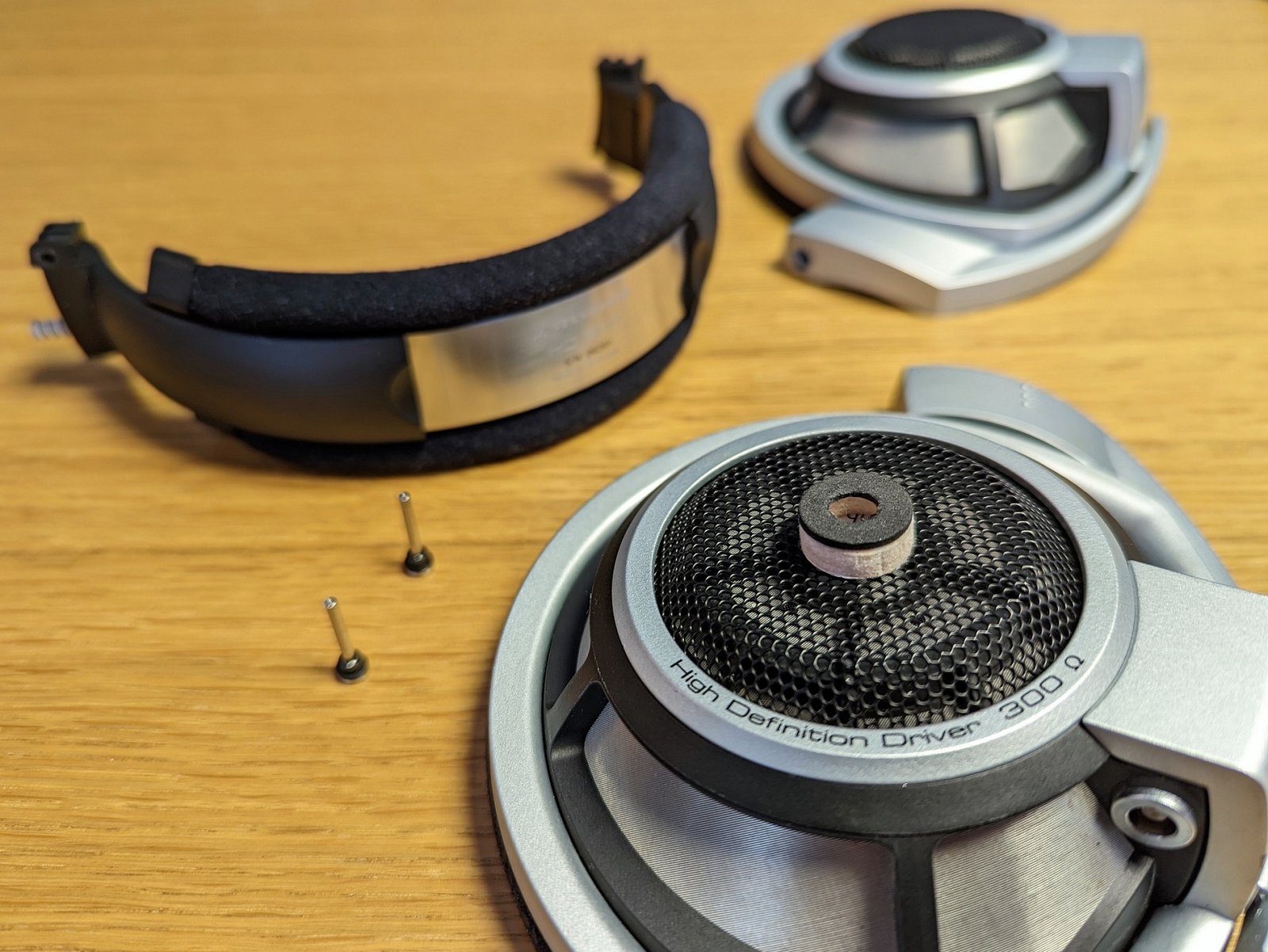
In this article, I will introduce the installation of the SuperDupont resonator mod for Sennheiser HD 800 headphones. The modification reduces the headphones” notorious 6 kHz peak, making the sound easier to listen to. At the same time, the HD 800 becomes quite similar in sound to the newer HD 800S model. This is because Sennheiser solved the headphones” treble resonance problem with a very similar "home remedy.".
The SuperDupont resonator mod was born in 2016 as a result of testing by the French user sorrodje, who writes on the Super Best Audio Friends forum – which is why the mod is also called the French mod. Sorrodje became interested in the resonator added to the center of the HD 800S model's driver, so he decided to experiment with what materials could make the HD 800 sound as identical as possible.
The end result was so good that he still sells the resonator he developed to this day. One pair currently costs 22 euros including shipping, and additional pairs sent in the same letter cost 7 euros each. Sorrodje has documented the materials used for the mod quite well and openly, so anyone could make the resonators themselves if they wished. However, I decided to buy them directly from the mod's developer, as finding optimal materials would have taken time. Ordering was done by sending an email to sorrodje. according to the instructions on the next page.
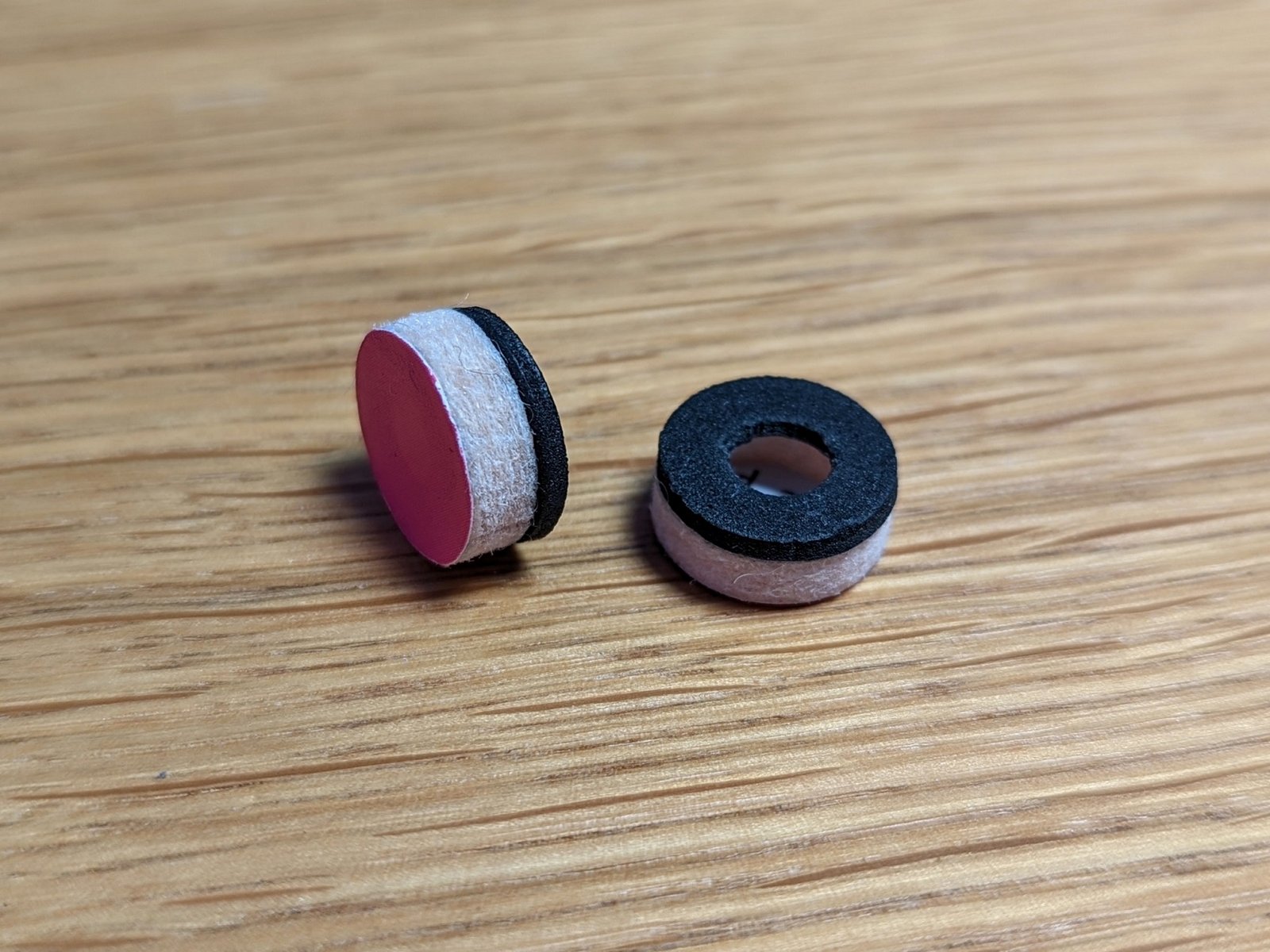
The SuperDupont resonator is a plug glued together from three different materials, intended to be placed in the hole in the center of the HD 800's ring driver. This dampens the resonances formed by the physical structure of the cup and the driver, reducing the 6 kHz peak. The modification has little effect on other frequency ranges besides the lower treble, but leveling the peak significantly improves the headphones' tonal balance.
Removing and attaching the headphone cups
To my understanding, it would be possible to mod the HD 800 without disassembling the headphones, but installing the resonators is easiest by detaching the headphone cups from the headband. At the same time, it's also advisable to remove the ear pads to provide more space for your fingers around the driver.
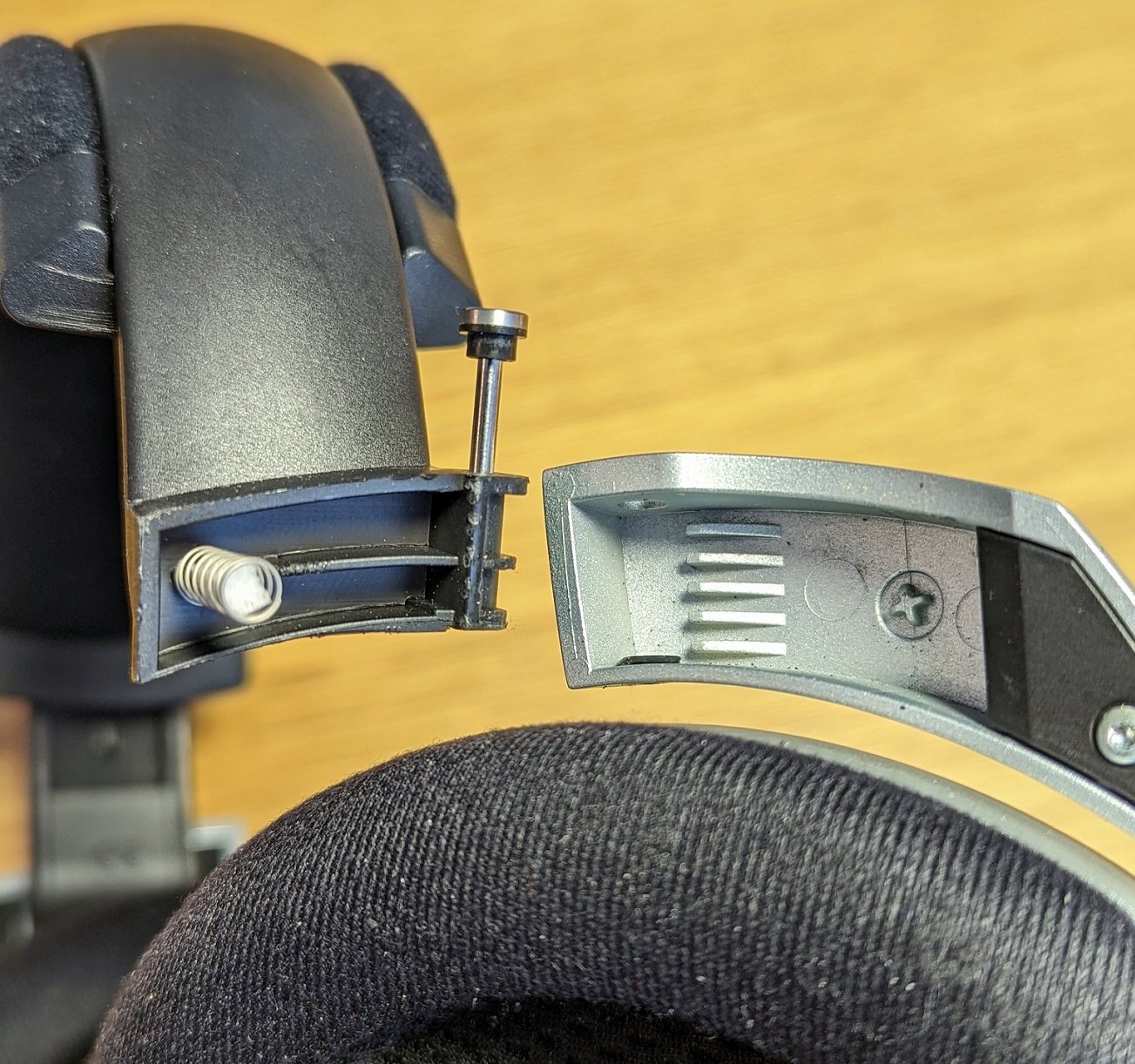
In my opinion, the HD 800 is well-designed because its cups are attached to the headband with removable pins. They come off by pressing them from below with a stick-like object. After this, the pins can be pulled out from above either with fingers or, if necessary, with pliers.
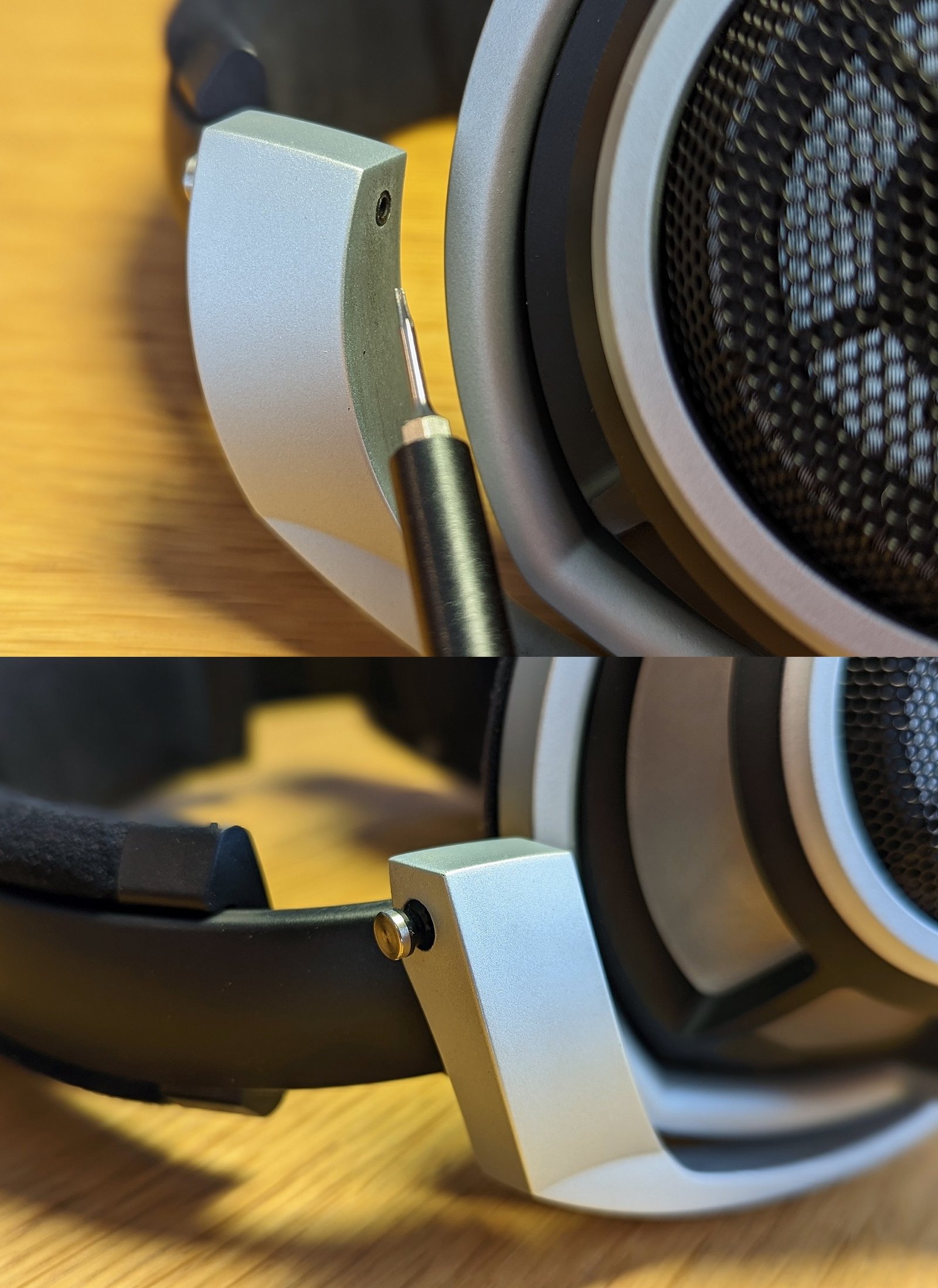
After removing the cups, be careful not to lose the springs belonging to the mechanism, for example, by dropping them on the floor.
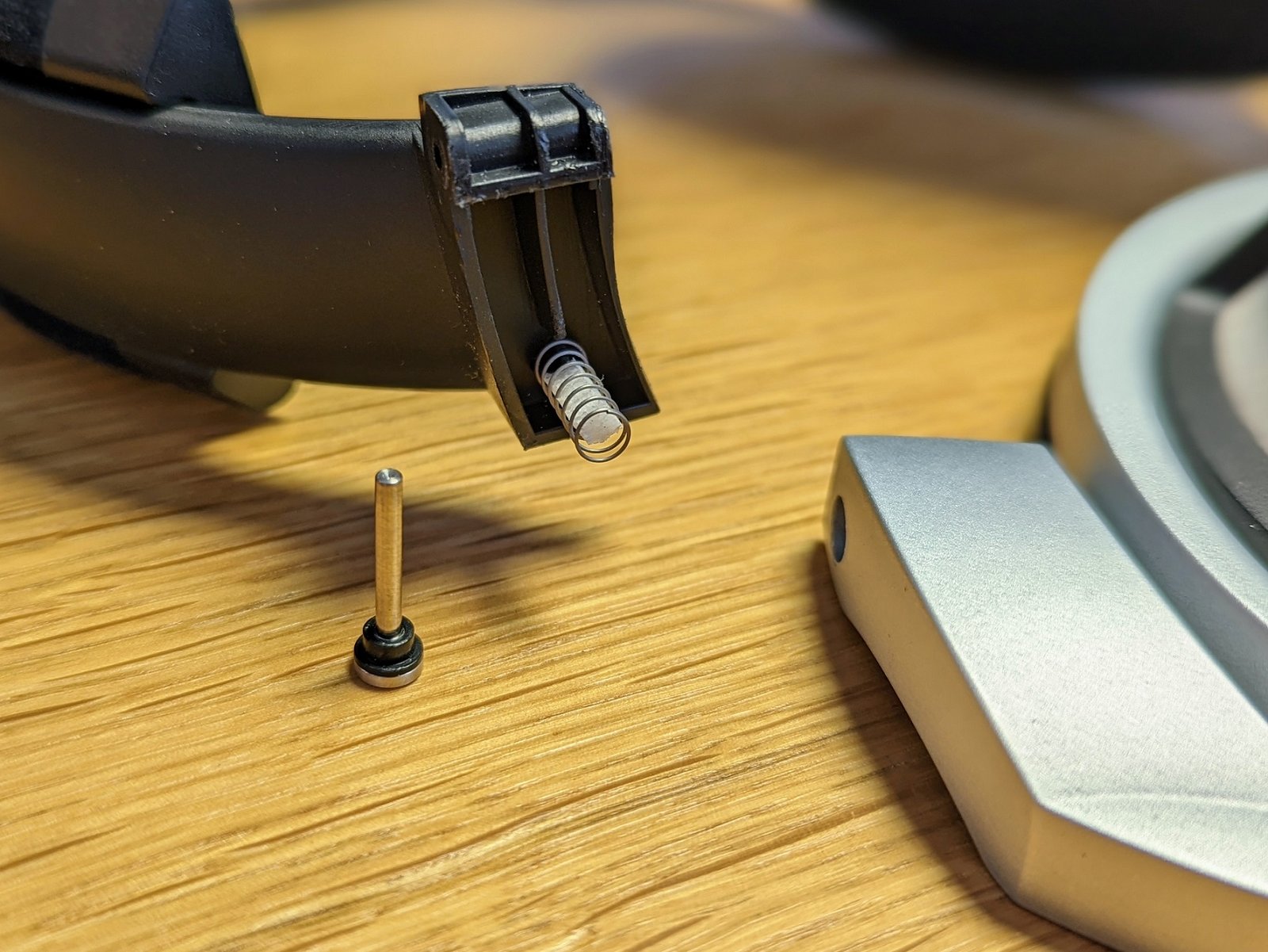
When reattaching the cups, one end of the spring should hit the counterpart in the cup's fork. Otherwise, the spring may slip when compressed, and thus not provide proper resistance. Attaching the cups might feel a bit tricky at first, as the procedure would ideally benefit from a third hand to push the pin into place. However, by trying patiently, it can also be done with two hands.
Installing the resonator into the driver
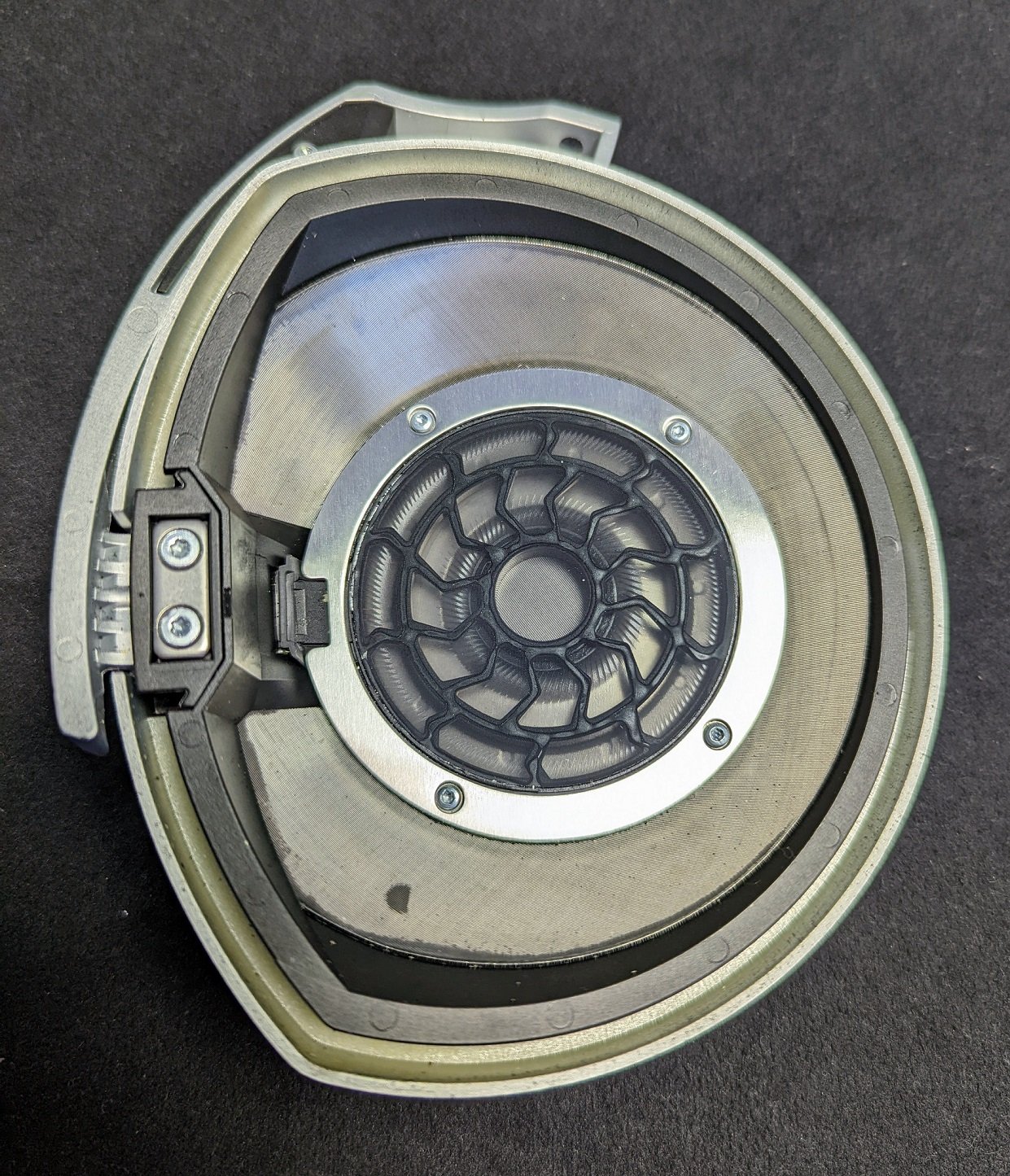
After removing the cups and then the ear pads, the most exciting work phase follows. On top of the driver, there is a thin protective fabric held by glue, which must be removed up to the center of the driver. This can be done by gently pressing the edge of the fabric towards the holes of the grille on top of the driver. The fabric starts to detach quite quickly, after which it is possible to grab its edge with fingers. After that, pulling it off is quite easy, as long as the fabric is not pulled too hard. In my opinion, no tools should be used to poke the fabric, as they might accidentally puncture the driver's diaphragm.
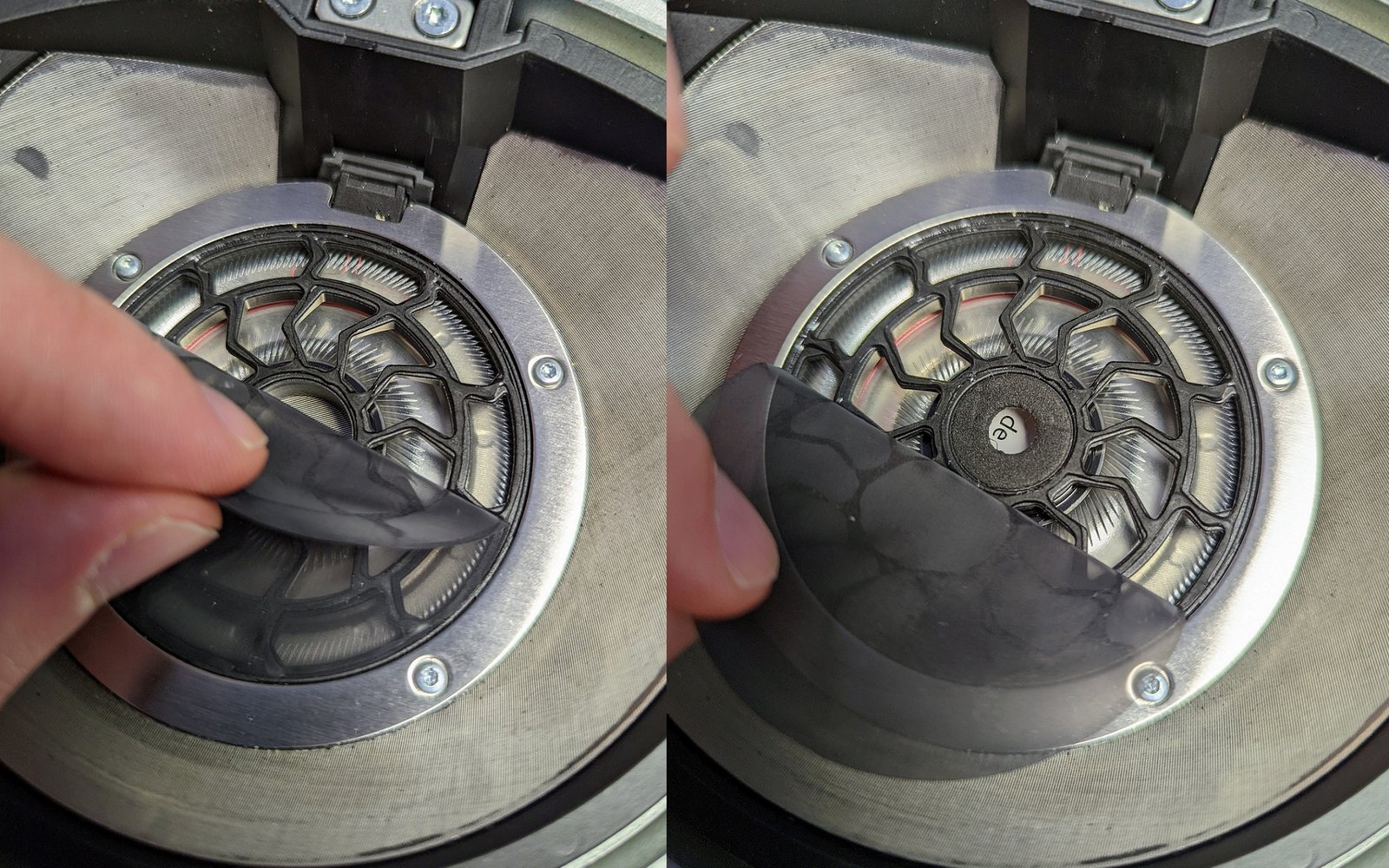
Once the fabric has been pulled away from the center of the driver, the resonator can be placed into the hole. The closed cardboard side of the resonator faces downwards, and the open side faces the ear. The top edge is intended to be level with the grille. Once the procedure is done, the protective fabric can be pressed and rubbed back into place. The glue under the fabric is jelly-like and sticky, so the result looks as if the fabric had never been removed.
Conclusion
Next, it's time to examine the changes in the headphones' sound. For more details on the starting situation, you should read my previously published HD 800 model review.
Frequency response modded (green) vs. stock (white):
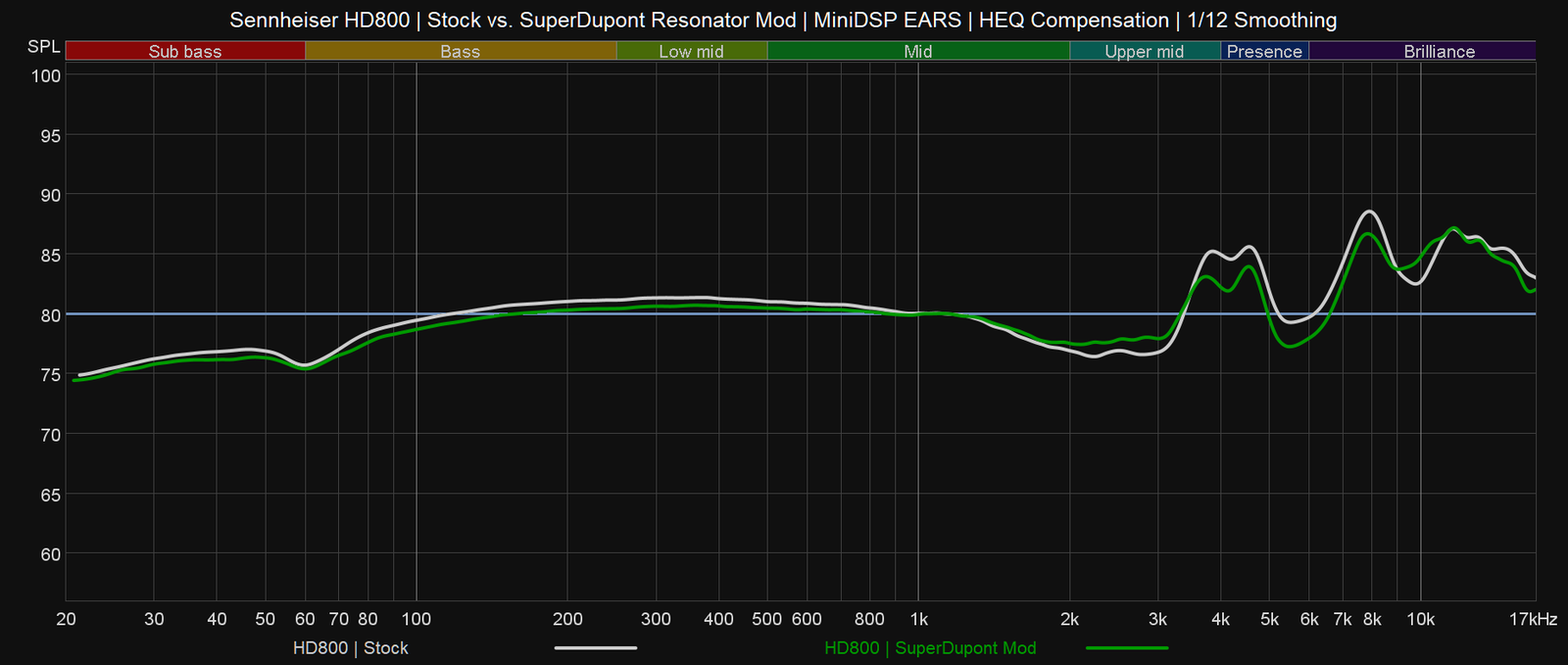
The effect of the resonators on treble reproduction is clearly visible in my MiniDSP EARS measurements, but due to the device's 5–7 kHz inaccuracy, changes are also quite widely visible around 6 kHz. The mod is fundamentally intended to balance the frequency response, which is quite evident from the measurements. The situation also accurately describes the changes that occurred in the sound.
Changes in sound
The Superdupont mod pleasantly calmed the lower treble of the HD 800. The reproduction lost its excessive detail and analytical nature, making it easier to focus on the headphones' excellent mid-frequencies. Bass reproduction also comes through slightly better overall, as the bass volume no longer remains as far from the treble volume. The sound is already starting to have a touch of the warmth I longed for.
One could say that the mod brings out the strengths of the HD 800 better, but the headphones still have a rather cool, airy, and light sound. This is mainly due to the abundant amount of upper treble, which the resonators did not significantly change. The treble is still slightly too emphasized overall, even though it is pleasantly airy and detailed. The main problem is that it is still difficult to fully immerse oneself in listening. The presentation is also not the most versatile, especially for poorly produced music.
However, the headphones are no longer annoyingly bright in any way, so those who appreciate airy treble would likely be thrilled with the result. Compared to the starting situation, the overall sound is more balanced in any case. It is now also faster to get used to the HD 800's sound after listening to other headphones.
Summary
Installing the SuperDupont resonator mod was a fun project in my opinion. The physical structure of the HD 800 is clear and simple, so the headphones were easy to disassemble. Installing the mod also did not require complex tools, but mainly courage. In principle, the resonators would be just as easy to remove if someone happened not to like them.
In my opinion, the sound of the HD 800 changed in a more balanced and thus better direction. Unfortunately, the headphones' subdued bass reproduction remained largely unchanged. For this reason, one should not expect any radical transformation from the mod, but rather a slight fine-tuning and relaxation of the reproduction. The potential of the headphones became even more apparent with the mod, so I got one more idea…
Attenuating the upper treble with the Project Polaris amplifier's bandwidth setting
Up until now, I had only listened to the modded HD 800 with my Burson Audio Soloist 3XP amplifier, as the sound of the unmodded headphones was best remembered with it. Once I had confirmed the changes brought by the resonators, it occurred to me to try the headphones again with the Garage1217 Project Polaris amplifier, which I had previously found to be good. The result with certain amplifier settings was ultimately so good that I have to write about it.
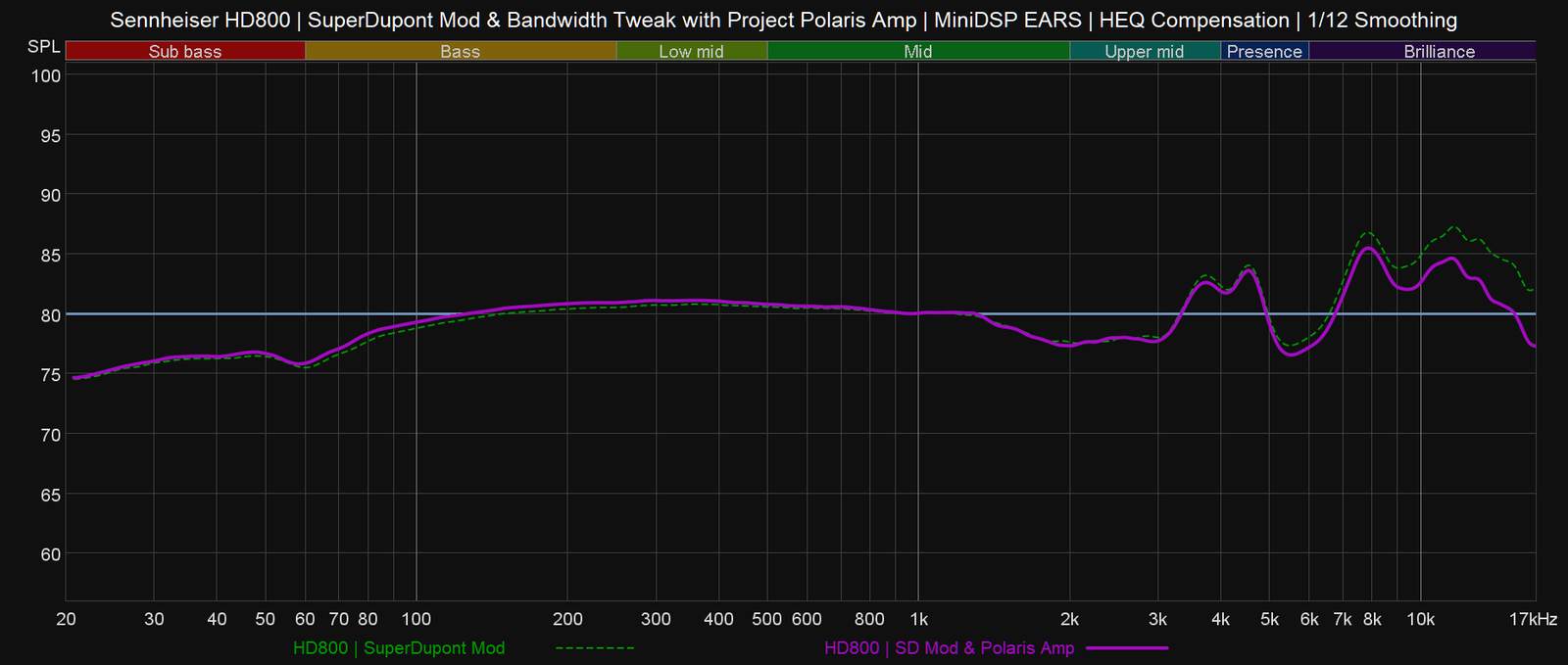
I already knew beforehand that the amplifier would bring HD 600-style relaxation and richness to the bass and mid-frequencies of the HD 800, if I used the 35 ohm output impedance setting. With the amplifier's bandwidth setting, it was also possible to cut off the upper treble, but Project Polaris could do nothing about the emphasis of the lower treble. Now that the 6 kHz region has been resolved with Superdupont resonators, cutting the upper treble proved to be a measure that, combined with the amplifier's other sonic characteristics, makes the HD 800 truly excellent headphones.
Frequency response with Low Bandwidth setting (purple) vs. with Superdupont mod only, measured with Burson (green dashed line):
Changes in sound
When listening with Project Polaris, the upper treble no longer draws attention to itself any more than other frequency ranges, so the HD 800's sound is finally balanced and engaging. Excessive analyticality gave way as enough warmth and emotion entered the reproduction. When listening to music, it is now possible to focus on the whole, but the detail of the reproduction still impresses at the same time. The soundstage, however, no longer feels as large due to the less airy treble, but it is still significantly more spacious than average. Listening is easy and light as a result, as before.
The headphones' mid-frequencies are now similar to the HD 600 model, but clearer and more energetic. For example, the reproduction of vocal performances is in almost perfect balance between intensity and ease of listening, considering the strongly forward-coming style. The ease is partly due to the vocalist positioning themselves at just the right distance from the listener in the soundstage, as if to be observed. At the same time, however, the singers really let loose without the sound ever being too aggressive.
For the bass frequencies, on the other hand, more growl is created thanks to the amplifier's output impedance and distortion. The bass no longer leaves one completely cold; instead, the ratio of its quantity and quality is good. I can even say that the bass reproduction is sometimes fun, which it wasn't before. For example, the bass guitar has a pleasant power. The impact sounds of the bass are still not particularly strong, but the fatter body created after the impacts is already a significant improvement. On the positive side, the bass does not become too loose with Project Polaris, so the detail of the HD 800's bass is preserved.
There is still a lot of treble in the headphones in principle, but I would not reduce its quantity any further. The airiness of the treble now feels purposeful and fitting for the overall sound. The HD 800 still sounds really energetic and detailed, which I originally liked about the headphones. Now these qualities are even easier to appreciate when attention is drawn to the right things. Every instrument has admirable bite and drive. Especially the impacts of drum skins and cymbals are, as a whole, almost the best I have heard.
In my opinion, the ZMF Auteur has excellent tuning with a slightly calmer and warmer presentation style, whereas the HD 800, thanks to my modifications, is now the most balanced version of an energetic and exciting presentation I have heard. For comparison, the Hifiman HE6se v2 takes the excitement even further, but its upper mid-frequencies are sometimes too aggressive.
Final remarks
All the features I described above are normally present in the HD 800, but they can only rarely be enjoyed due to the overemphasized treble. After the Superdupont mod and ”tinkering” with the Project Polaris amplifier, the most astonishing change in the headphones is that it is possible to listen to literally anything with them, including crappy demo cassettes. In about 20 hours of listening, I have not encountered a track that would grate on my ears, at least not because of the headphones themselves. Everything has sounded excellent, which I still find a bit difficult to comprehend given the starting situation.
Now I could live with the HD 800 without needing other headphones (though this is a funny thought, as one eventually gets tired of every headphone). I have only really encountered similar versatility with the ZMF Auteur, so my modified HD 800 is in that respect one of the best headphones I have heard. However, it would not be so without modifications, so it is difficult for me to decide how to regard it in the future when reviewing other headphone models. The problem is positive, however, because when testing different headphones, I am specifically looking for the best possible sound quality. From now on, I also know even better what is missing from other headphones.
What then is still missing from the HD 800? It is still itself in terms of technical performance, so most of my more expensive headphones separate sounds more clearly from each other. The soundstage also often has more depth, so the result is slightly more realistic than with the HD 800. However, these aspects partly lose their significance if the sound has disturbing characteristics in terms of frequency response. For some reason, many high-end headphones are not very versatile in their tuning; the HD 800 itself is a good example of this. The HD 800 has more to fix than usual, but in my opinion, it is worth the effort, especially since the headphones are now available used quite affordably compared to other high-end headphones.
 EN
EN  FI
FI