Author: Sword of Damocles
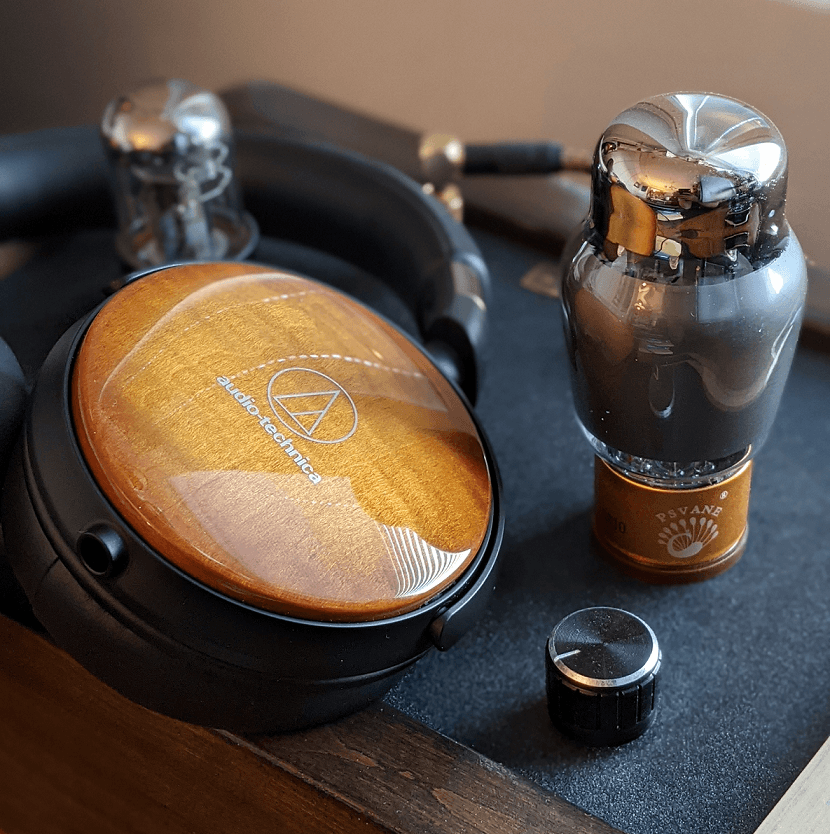
I have owned for about 4 months Audio Technica manufactured WP900 headphones. They were released in Asia and the United States in late 2019, but sales in Europe only began in spring 2021 – unfortunately, the headphones are still not available for purchase in Finland. The WP900 costs 699 euros new, but I bought mine used for 500 euros. So, these are still not cheap headphones, but I have always liked wooden headphones and I was interested in trying out what these Audio Technicas sound like.
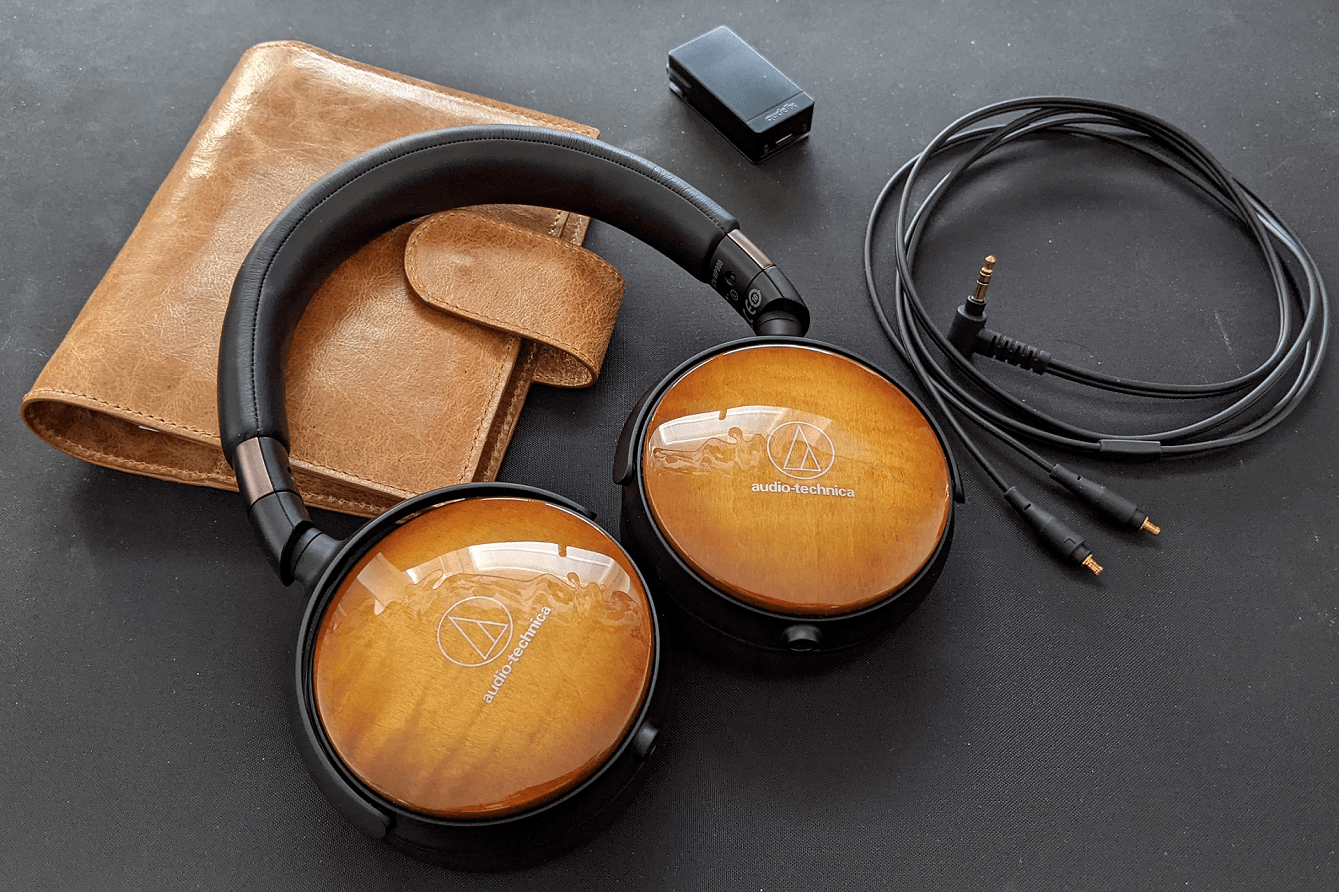
Structure and comfort
The WP900, manufactured in Japan, is designed for portable, on-the-go use, so the cup structure is completely closed. The external dimensions are slender, and according to my scale, the headphones weigh only 248 grams. The 2 included cables (3.5 mm unbalanced and 4.4 mm balanced) also fit the intended purpose well, with both being 1.2 meters long and weighing 20 grams. The connector that attaches to the amplifier on the cables is at a 90-degree angle. Rubber-coated cables don't win style points, but the cables are flexible and don't get tangled. Many other headphone manufacturers would unfortunately have opted to include a thick and heavy cable with similar headphones.
The cables feature Audio Technica's self-developed A2DC connector, which was originally designed for in-ear monitors to replace the MMCX connector. The connector's contact with the headphones is sturdy, but if one wanted to acquire a longer cable for home use, they are quite difficult to find on the market with this specific connector. Buying suitable connectors separately is also not easy, as the WP900's connectors are slightly recessed inside the cups, meaning some connectors with metal shells do not fit all the way in. Audio Technica should create some kind of standard for these connectors, as currently the recess depth of the connectors varies between different headphone models.
The light weight of the headphones has been achieved by using a lot of plastic. In fact, apart from the wooden cups, the headphones are entirely plastic, but the most critical parts related to the headband's height adjustment are at least made of metal. The headphones feel quite flimsy in hand, and one feels like handling them with care. However, the overall impression of quality is quite good, and after 4 months of use, no creaks or squeaks have started to come from the plastic parts.
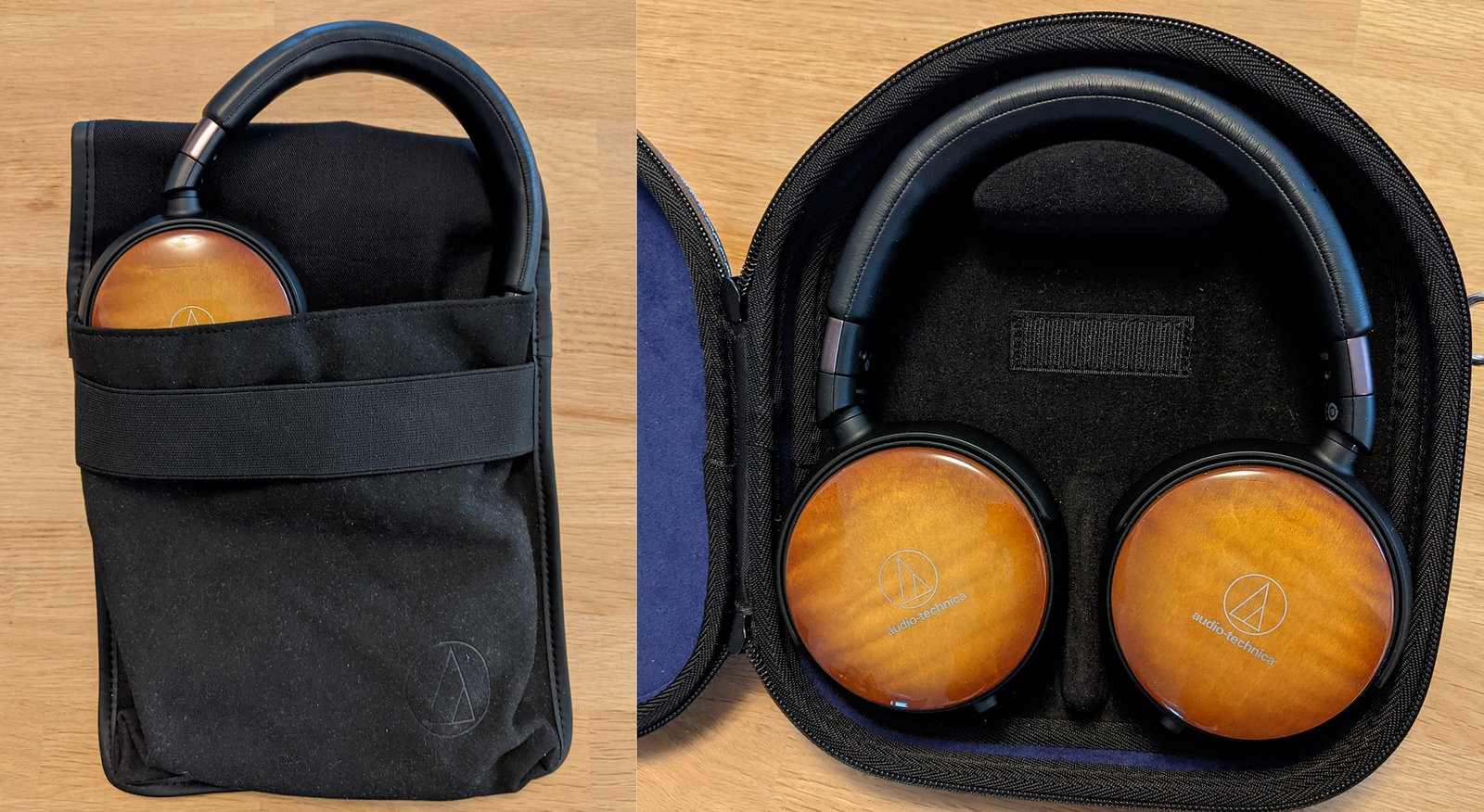
If the design hadn't prioritized lightness, I wouldn't consider the construction and material choices to be quite worth 700 euros. The manufacturer could have remedied the situation by including a hard-shell case with the headphones, instead of just a soft pouch, in which I haven't dared to keep the headphones in a backpack/bag, especially with heavier items. I therefore had to acquire a hard-shell case separately from Amazon Germany.
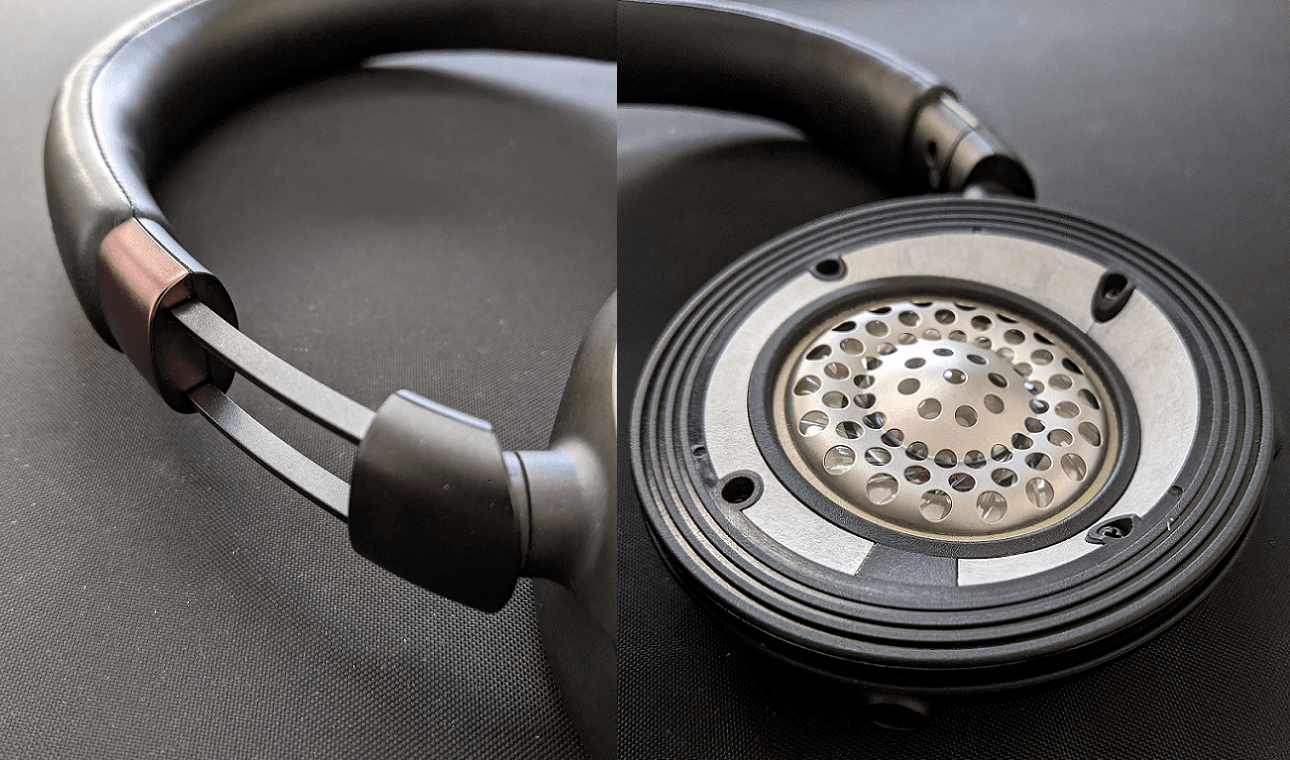
Although the headphones are quite small in size and the cups have a diameter of about 90mm, the manufacturer has managed to fit 53mm dynamic drivers into them. I can't say much more about the drivers other than that they have a DLC (diamond-like carbon) coating, which sounds like something launched by a marketing department, and they are set at an angle. In terms of comfort, the WP900 is top-notch thanks to its light weight and negligible clamping force. By pressing the cups slightly tighter against the ears, an estimated 5–10% more bass is produced, so we are on the verge of whether the clamping force is too light by default. However, glasses work well with the headphones, meaning the low frequencies do not escape through the gaps created by the temples.
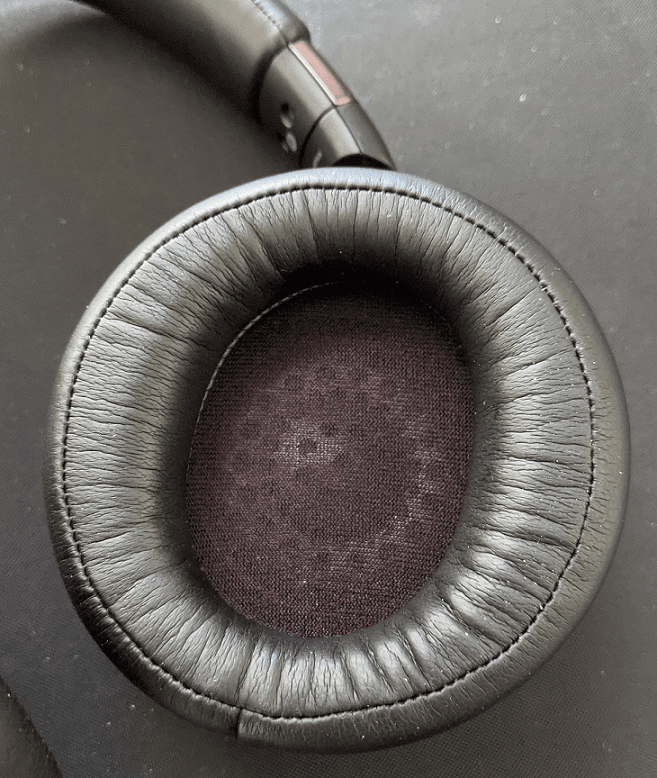
Due to the small diameter of the cups, the ear pads must also be small. However, a sufficiently large ear opening has been made in them, and my somewhat large ears fit inside well (this is exceptional for me when talking about 80-90mm pads). Thanks to this, the headphones are purely over-ear headphones and do not rest on the earlobes. The closed cups moderately block sound in both directions, and thanks to the light clamping force, no vacuum-like sensation is created around the ears.
The material of the earpads is very soft and pleasant synthetic leather. The outer surface of the headband is made of the same material, but there is only a little padding in the headband. Fortunately, thanks to the light overall weight, the top of the head does not get sore, and the headphones can be worn for hours without noticing their presence at all. These are the most comfortable headphones I have ever worn.
Sound quality
The WP900 has a slight V-shaped, fun-seeking tuning: the bass hits hard and feels physical, the lower part of the mid-range is recessed, and treble is served generously. The sound as a whole is quite distinctive, as it cannot really be described as warmly musical, nor as analytical. Described in two words, the WP900 sounds punchy and bright. Modern music, female vocalists, string instruments, and piano sound good. The headphones succeed in being energetically fun and they beautifully create atmosphere with their sensitively reproduced high frequencies and powerful low frequencies.
Bass:
The low frequencies are clearly emphasized, and both the mid-bass and the lowest frequencies hit hard. There is extra warmth around the impacts, which, however, remains well separated from the mid-range thanks to the recess left in the tuning. Thus, the punchy bass brings fun and warmth to the sound without making it too thick or muddy. The low frequencies in the WP900 are of a good standard in terms of detail, tightness, and speed.
Mid-frequencies:
For the mid-frequencies, the lower mids become more distant and the upper mids are emphasized. I understand this is common in Japanese-style tuning, and as a result, female vocalists sound pleasantly airy and effortless. The same can be said for string instruments and piano. There is a lot of air around these sounds, and the acoustics of the recording space are also nicely audible. Unfortunately, at the same time, male vocalists, depending on the singer, remain somewhat distant and light in body. Mid-frequencies in general are light and do not bring out all the small details. The mid-frequency tuning is thus both a weakness and a strength at the same time, yet it is the weakest aspect of the headphones in terms of the overall package.
Treble:
There is a lot of treble, and it is the most focused on when listening, in addition to the bass. The treble reproduces very clearly, airily, and effortlessly. The English word ”sizzle” best describes the style of the treble, in my opinion. This makes the headphones' sound slightly metallic, although nothing sounds forcedly bright, and I don't detect any disturbing peaks in the upper frequency tuning. Still, sometimes the amount of treble approaches a limit that one would not want to cross. Fortunately, this limit is set wisely, as it is only really crossed in poorly recorded live recordings. When listening to higher quality music, sibilance and drum cymbals are very rarely reproduced too sharply. For me, these do not cause listening fatigue, as long as I use an amplifier that does not emphasize the treble any more than Audio Technica intended when designing the headphones.
Other observations:
The WP900 has a rather intimate/small soundstage, meaning the sounds reproduce close to the listener's ears. However, the V-shaped tuning makes the headphones sound spacious and airy for closed-back headphones. All spatial details containing higher frequencies stand out wonderfully even when listening at low volume. There is a pleasant amount of air around the sounds, and the separation of different instruments is, if not the best, then still good enough for headphones in this price range.
Power requirement and device pairing
The headphones have an impedance of 38 ohms and a sensitivity of 100dB/mW, so they are easy to play from almost any device. A phone makes the higher frequencies sound a bit sharp, but for example, a laptop's headphone jack is perfectly sufficient for these and sounds good, although it causes a bit of background noise. Conversely, my Qudelix 5k DAC-amplifier with Bluetooth connection does not cause any noise and sounds slightly smoother regarding the brightest sounds.
Among my larger devices, the RebelAmp further emphasizes bass and treble, so the result is not ideal. In my experience, the WP900 works best with DACs and amplifiers that are not too bright in their reproduction and have little effect on the headphones' own sound. However, somewhat surprisingly, the Tor Audio Roger tube amplifier works well with the WP900, smoothing out the V-shaped tuning and adding body to the mid-frequencies.
Comparison to other headphones
I compare the headphones to Dan Clark Audio Aeon 2 Closed headphones in their review context.
Summary
The WP900”s V-shaped tuning is implemented thoughtfully, and the result is fun and energetic. In my opinion, the WP900 excels at what they are designed for. At the same time, however, the tuning is not inherently optimal for all music genres, and the reproduction of vocal performances can be a bit ”hit and miss" depending on where in the mid-frequencies the singer's voice falls.
With a thinner, airy style, a lot of emotion is successfully created, especially for female vocalists, string instruments, and piano. When combined with impactful low frequencies, the result is pleasant. The comfort of the headphones is also top-notch, allowing them to be worn all day. However, it cannot be overlooked that the plastic quality of the construction leaves one somewhat doubtful about future use.
Ultimately, it is quite difficult to say whether the headphones are worth 700 euros when bought new. Part of the price is explained by the wonderful wooden cups and Japan as the country of manufacture. For the same money, you can get many more balanced headphones with better technical performance, which are easier to recommend as so-called primary headphones. However, only a few of them are as well suited for portable use.
I would see the WP900 as a kind of luxury product that is nice to own in addition to other headphones. For some who like Japanese-style tuning, they might even be worth considering as their only headphones. In this case, however, it is advisable to focus on enjoying the music and less on analyzing it.
 EN
EN  FI
FI
Good review and interesting headphones. I got to try these through an amplifier, and the sound was very pleasant to my ears. Would you recommend these as everyday headphones even without an amplifier?
Thanks for the feedback! As I recall, directly from a phone's and laptop's headphone jack, the upper frequencies sounded somewhat fatiguing. Based on that, I would say it would be safest to get at least some affordable basic dongle, for example, an iFi Go Link-style device. Similar ones are available from many different manufacturers. They convert the listening device's USB connector into a standard headphone jack. In between, there's an OK D/A converter, and the amplification power usually surpasses the devices' own headphone jacks. You also get rid of potential background noise at the same time, and such a device can be carried in a small space, for example, in a pocket. 🙂
Thanks for the answer! Now, while we're at it, what separate amplifier would you recommend to go with these? Possibly one that would last for several years and work with other headphones too. 🙂
Portability doesn't really matter as I mainly use headphones at home.
Thanks and a bow!
You're welcome. Amplifiers generally don't age, and nowadays headphones are also becoming easier to drive, so with more affordable devices you can go really far. For example, the Topping L30 II would be a powerful and safe purchase as an amplifier even for ”heavier” headphones. For the sensitive and low-impedance WP900, I wouldn't really get a more powerful amplifier, or at least the lowest gain setting should be genuinely low, so that there is enough headroom left in the volume control (i.e., so it doesn't play too loud when the knob is turned just a centimeter).
I'm not sure if you would also need a D/A converter in addition to an amplifier. If so, e.g., the 100-euro iFi Zen Air DAC or Topping DX1 would be quite sufficient, and they would also work well for the WP900 in terms of amplification. If you were to acquire other headphones in the future, e.g., the L30 II could be connected to the aforementioned devices as a more powerful amplifier.
Thank you for your detailed review!
I currently own AWKT, AWAS and ADX5000 for home use. Do you think it’s worth getting the WP900 for both home and away use? Portability is not exactly a big concern of mine, I am mostly looking for diversity in sound.
From your review, it seems WP900 shares a lot of characteristic with ADX5000, so I am a bit hesitant to get something I already have.
You are welcome!
It is unfortunate that I haven’t heard ADX5000 myself, but it shouldn’t be very similar with WP900, as the latter has a lot more bass. Thus, WP900 has a V-style presentation, while ADX5000 aims for neutral-bright. I don’t have WP900 anymore, but I actually have some regrets selling it. What a nice little headphone and good looking wooden cups.