Author: Sword of Damocles
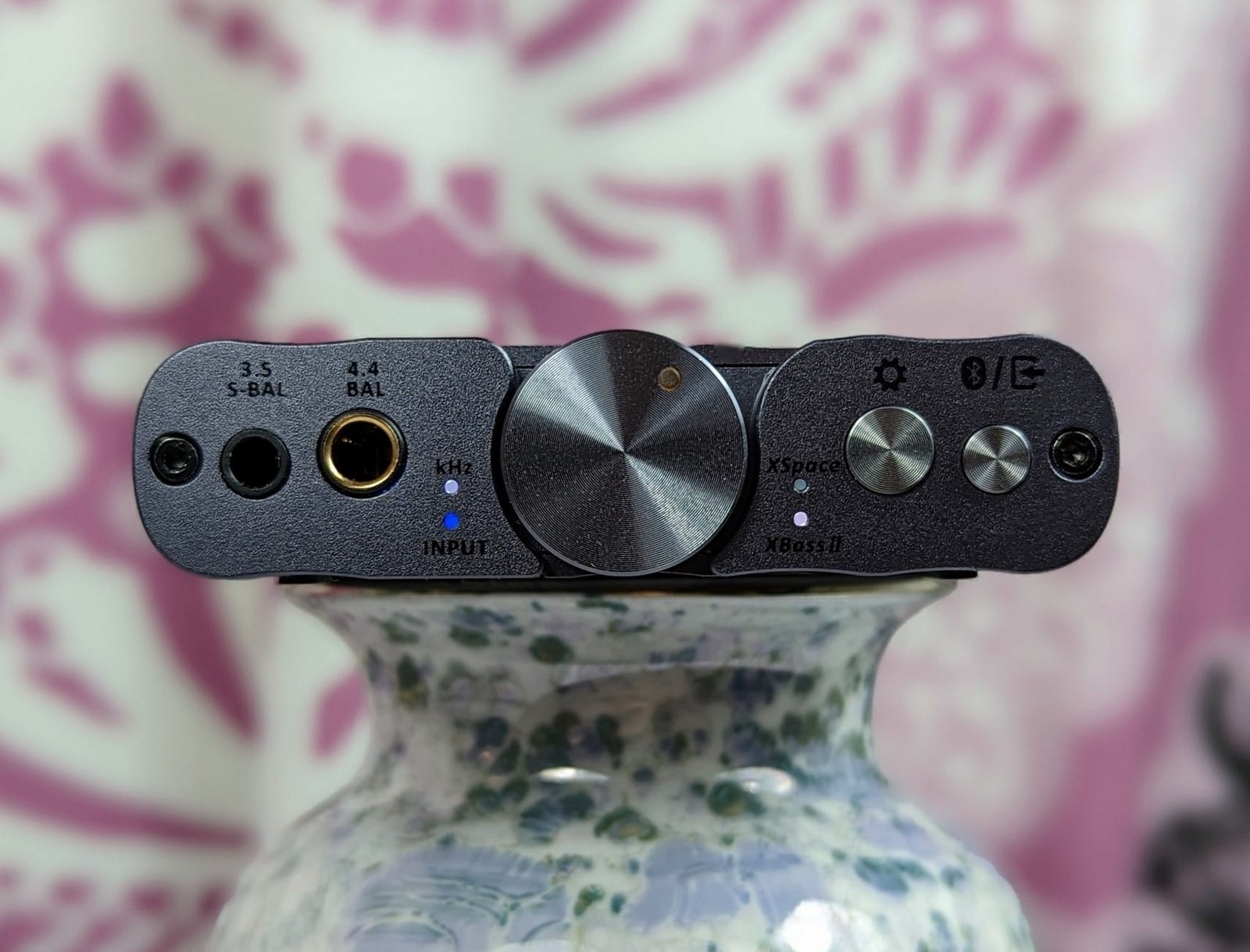
Table of Contents:
Information:
- Publication year: 2021
- Price: 619 €
- Type: Mobile DAC & Headphone Amplifier
- DAC chip: Burr-Brown Multibit (BB DSD1793)
- MQA support
- Input connections: USB-C, Coaxial, 4.4 mm (balanced), 3.5 mm (unbalanced) and Bluetooth
- Output connections/headphone jacks: 4.4 mm (balanced) and 3.5 mm (unbalanced)
- Bluetooth 5.1: supported codecs SBC, AAC, HWA, aptX, aptX HD, aptX Adaptive, aptX LL and LDAC
- Sampling rate (USB) PCM: 44.1–768 kHz (16–32 bit)
- Sampling rate (USB) MQA: 44.1–384 kHz (16–24 bit)
- Sampling rate (USB) DSD: DSD64–DSD512 (native)
- Sampling rate (USB) DXD: 352.8–768 kHz
- Sampling rate (Coaxial) PCM: 44.1–192 kHz (16–24 bit)
- Sampling rate (Bluetooth) PCM: up to 96 kHz
- Stated output power (balanced): > 1000 mW @ 32 ohm / > 74 mW @ 600 ohm
- Stated output power (unbalanced): > 320 mW @ 32 ohm / > 40 mW @ 300 ohm
- Output Impedance: < 1 ohm
- Battery size: 3600 mAh
- Charging port: USB-C
- Battery life: Up to 10 hours (varies by usage)
- Stated charging time: 6–12 hours depending on charger (however, I timed about 2.5 hours charging time with a powerful phone charger)
- External dimensions: 12.3 x 7.5 x 1.9 cm
- Weight: 215 g
- Features: XBass II and XSpace settings (analog EQ) and iEMatch (background noise reducing gain setting for in-ear headphones)
- Included: Protective pouch and three short USB-C cables, with USB-C, USB-A, and Apple Lightning connectors on the other end
Review unit acquisition method: Loaned from a reseller
We got Joensuu Kuvalta ja Ääneltä on loan a British iFi Audio xDSD Gryphon mobile headphone amplifier, fully equipped (link to the manufacturer's product page), which also has a built-in D/A converter implemented with a Burr Brown chip. The device includes a battery and Bluetooth listening capability, making it versatile for various use cases. The feature list is also impressive, as the Gryphon offers much that is not found even in most larger and more expensive devices.
The Gryphon is certainly not among the cheapest either, as it costs about 620 euros in Finland. Devices intended for similar use are sold for as little as 100 euros, but with them, some compromises usually have to be made – for example, the output power of the amplifier section might be too low for some headphones. The Gryphon, on the other hand, is better suited for those looking for a compact and as compromise-free a replacement as possible for more traditional devices.
Product packaging
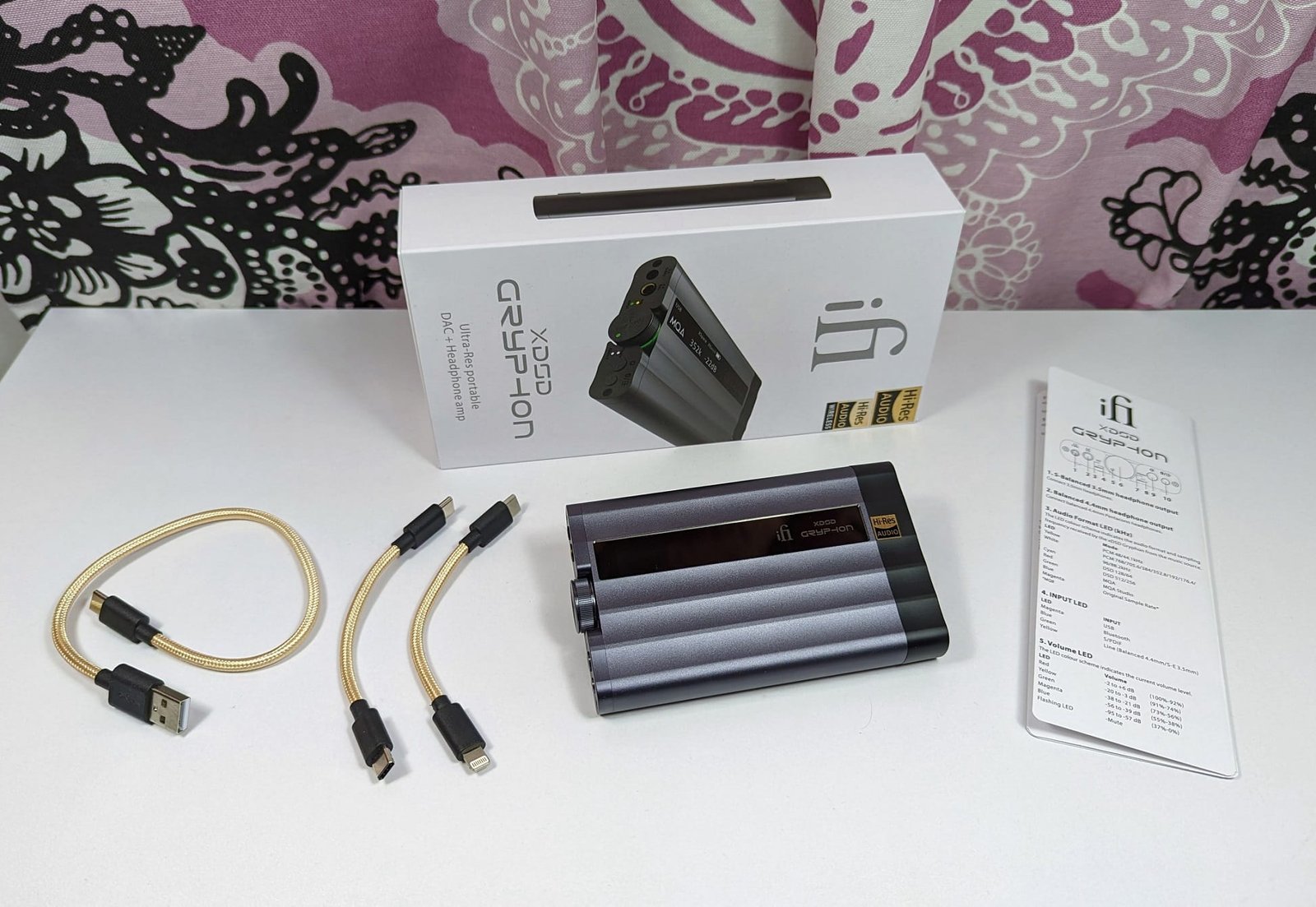
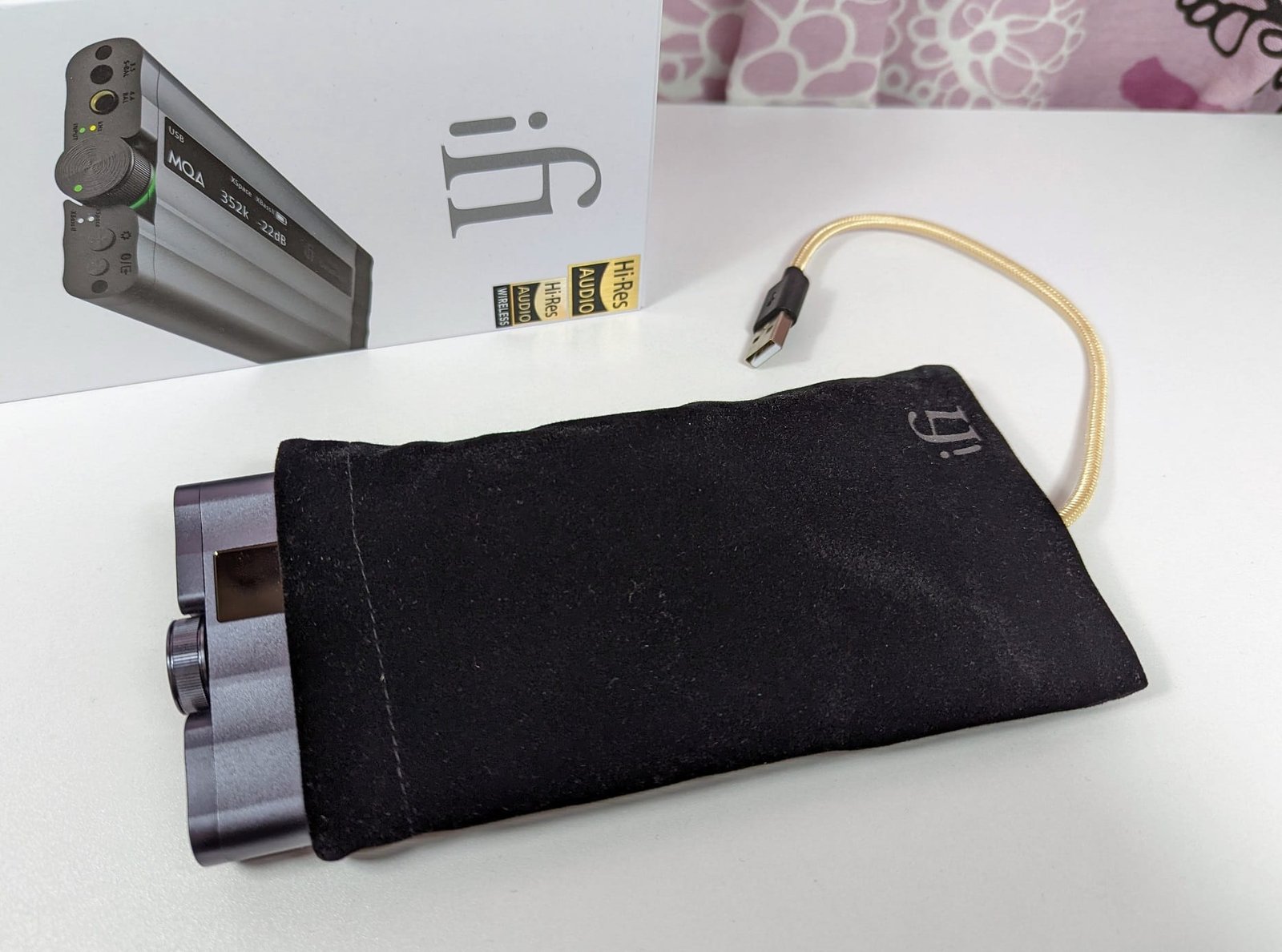
The product package includes clear instructions for use, a fabric protective pouch, and three short USB cables for using and charging the device. One of the cables has a Lightning connector, so it is suitable for Apple devices. The cables can be used with the protective pouch, as they can be attached to the device through a hole in the bottom of the pouch.
Structure, connections and features
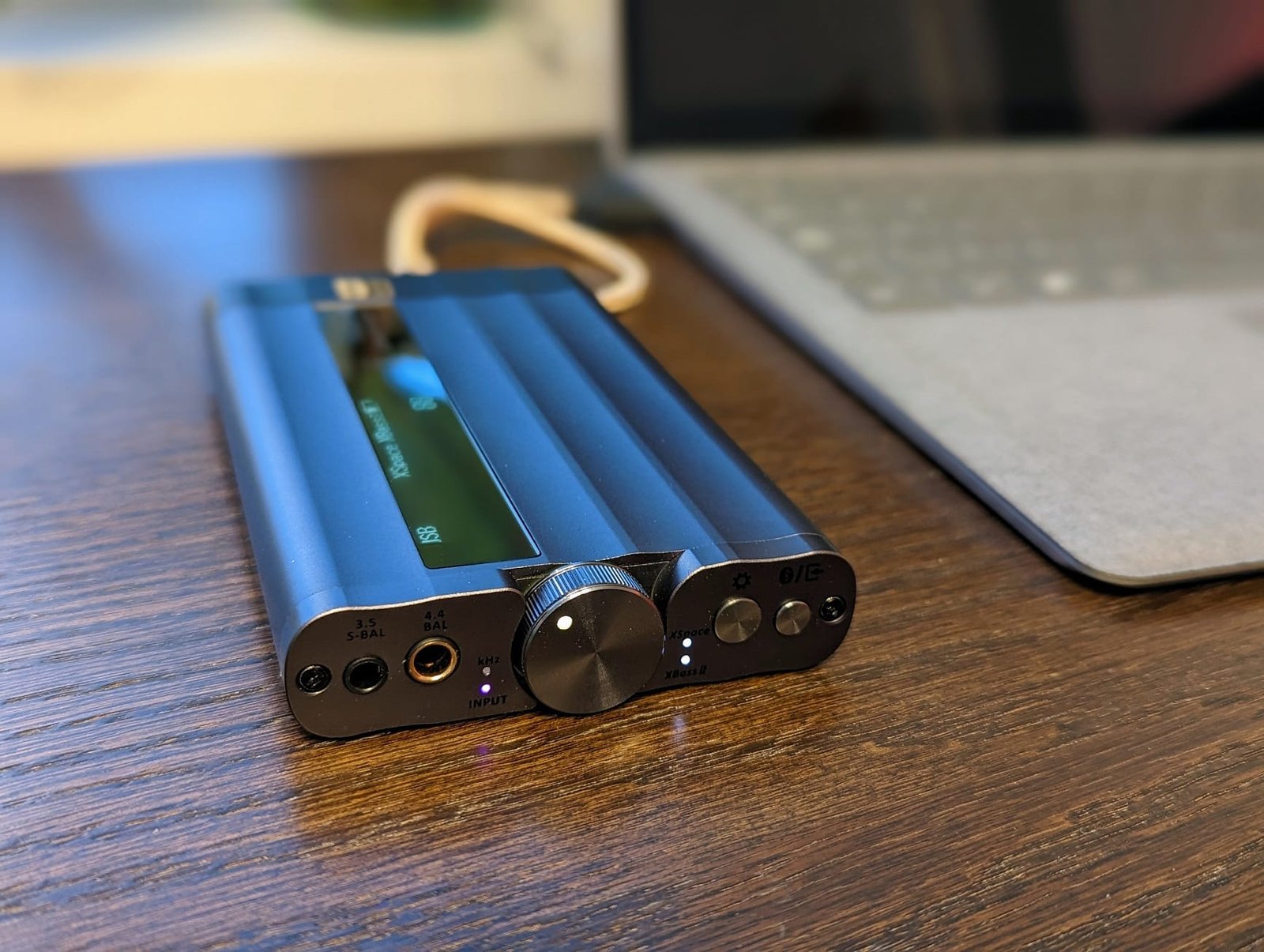
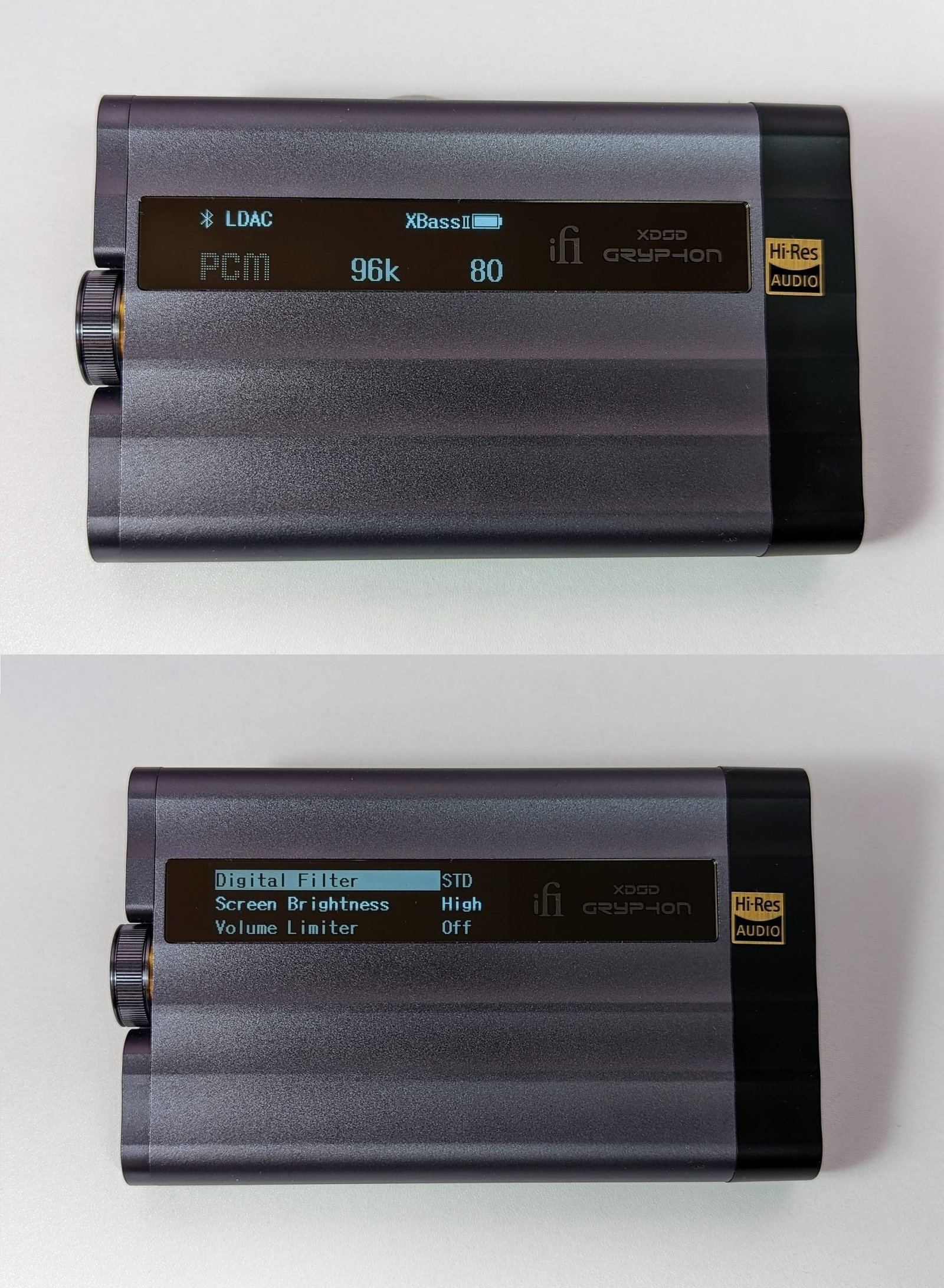
The Gryphon is externally a really high-quality and sturdy-feeling device. The hip flask-like appearance is, in my opinion, a perfect performance from a usability perspective, as the device stays easily in hand thanks to its wavy metal casing, and you practically want to hold onto it during use. An OLED display is installed on the device, showing, among other things, the battery level, volume, audio input channel, and sampling rate. The display is also necessary when changing the device's settings. Since the display is installed sideways relative to the front edge of the device, it can be rotated to face the other way if needed, for example, in a situation where the Gryphon is located on the user's right side.
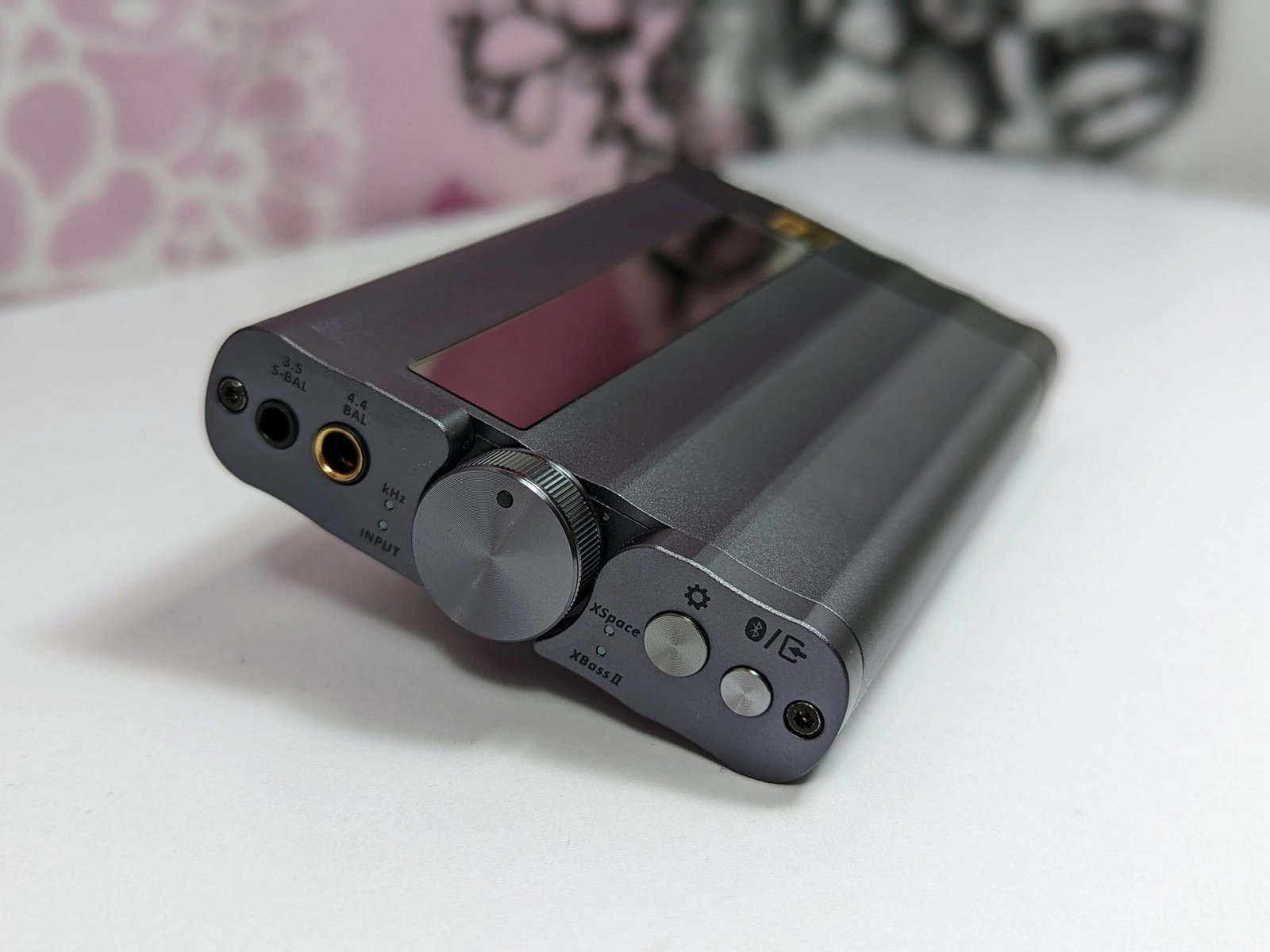
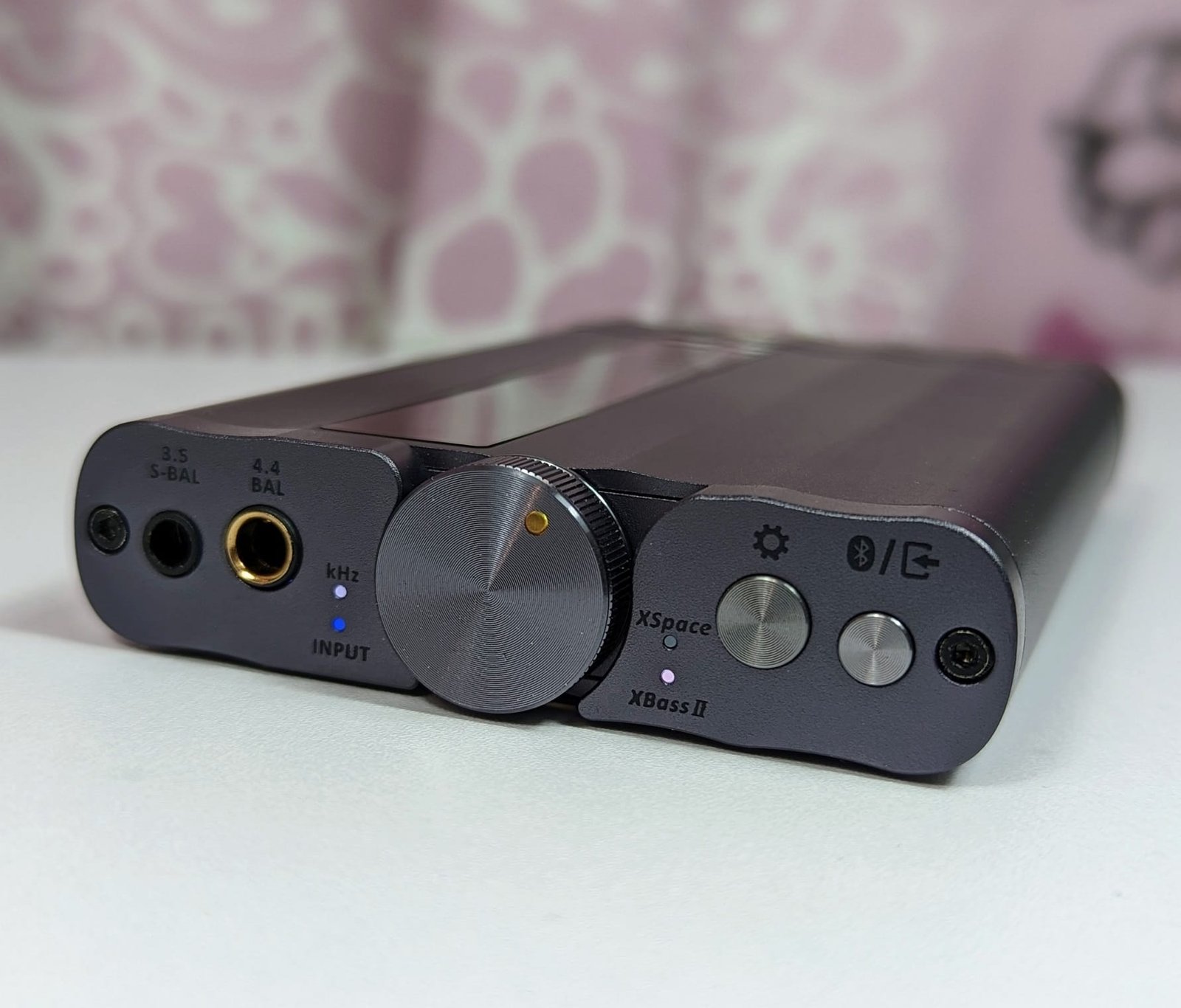
The front end of the Gryphon includes a volume control, headphone jacks/analog outputs (3.5 mm and 4.4 mm), two buttons, and several indicator LEDs. The feel of the click-rotating volume control is good, and rotating it faster accelerates the adjustment speed if, for example, the volume needs to be lowered quickly. The adjustment range for volume is 2–106, with the selected setting indicated not only on the display but also by the color of the LED on the control. The volume control also functions as a power button and a kind of multi-function button, which can be used to operate the settings menu, activate mute mode, and skip to the next track when listening via Bluetooth. Device operation is logical and smooth.
Of the two smaller buttons, the outermost one changes the audio input channel, and the other activates the XBass or XSpace feature, which can also be used simultaneously. Pressing the latter button longer accesses the settings menu, from which you can change, among other things, the audio filter (three options: Standard, Bit Perfect, and GTO) and screen brightness. All Gryphon settings can be made directly on the device itself, which is a clear plus for those who don't want to bother with phone applications.
The rear end of the Gryphon features USB-C, coaxial SPDIF, 3.5 mm AUX, and 4.4 mm Pentaconn (balanced) as audio input connectors. There are separate USB connectors for the audio signal and charging to prevent interference noise if the device is listened to and charged simultaneously. However, through the settings menu, the device can also be configured to charge via the data port if beneficial. I have primarily used a Bluetooth connection for listening, making the Gryphon's use cable-free, except for the headphone cable.
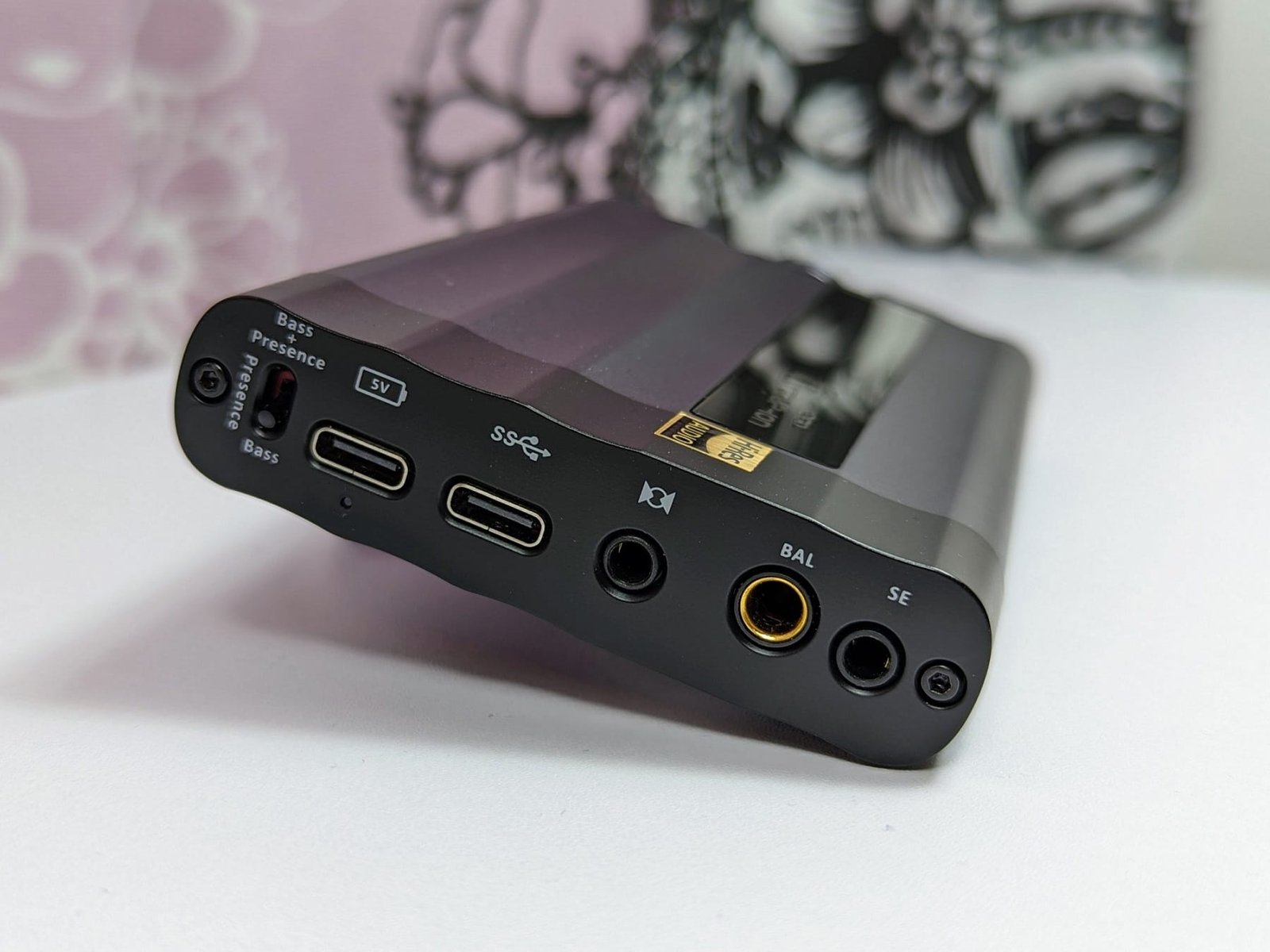
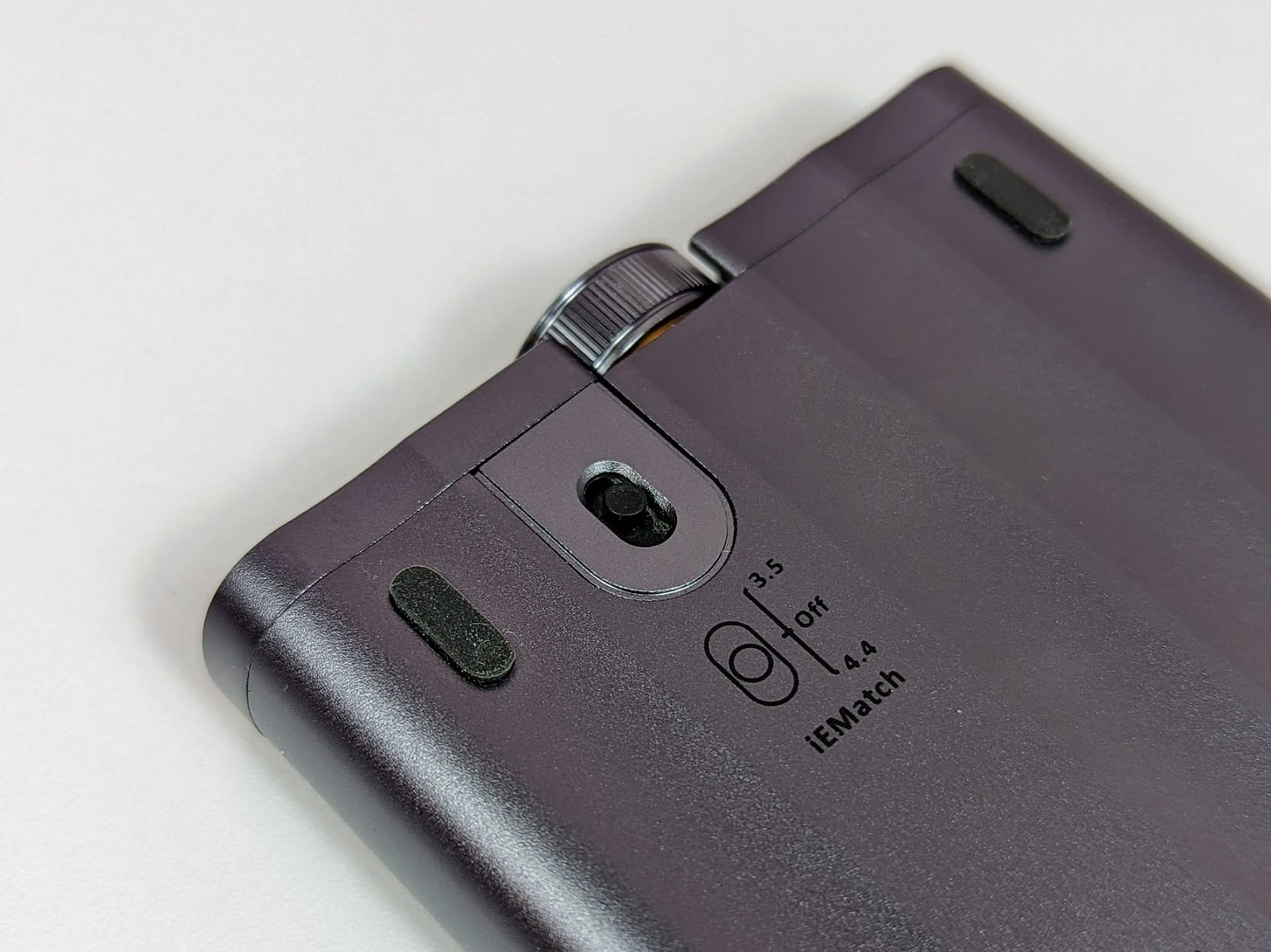
In addition to the various connectors, the rear end also has a three-stage switch that can be used to customize the operation of the XBass and XSpace settings activated from the front edge. On the bottom of the device, there is another switch, which the manufacturer calls the iEMatch feature. It is essentially a gain selector that can reduce background noise when listening with sensitive in-ear headphones. I found the feature to be very effective with Unique Melody Mest, as without it, there was a continuous faint hiss from the 4.4 mm balanced connector. With less sensitive over-ear headphones, however, the feature may not be beneficial, so with them, the Gryphon should be listened to with full gain.
Gryphon is a great device that, despite its relatively small size, includes a wide range of different connections and additional features. iFi Audio deserves credit for the engineering work that has made it possible to fit everything into the same casing. I can't think of anything that Gryphon would be missing. On the other hand, there's nothing superfluous included just to fill out the feature list; everything feels genuinely useful. In addition, I left out a lot about the device's internal technology and operating principle, so curious readers should check out more about Gryphon on the manufacturer's website.
Notes on usage
The Gryphon weighs 215 grams, and it's not among the smallest in physical size, although it does fit in a pocket, for example. For those looking for the smallest possible device, iFi itself offers, for example, the 200-euro Go Blu, which, like the Gryphon, enables Bluetooth listening. I have used a Qudelix 5K, which is similar in size to the Go Blu and can be attached, for example, to a shirt collar. Smaller devices are easier to carry, whereas the Gryphon is more powerful as an amplifier. In my opinion, the device could be thought of as a powerful portable computer, which is larger and heavier compared to the lightest models, but for a demanding user, it's the only right option.
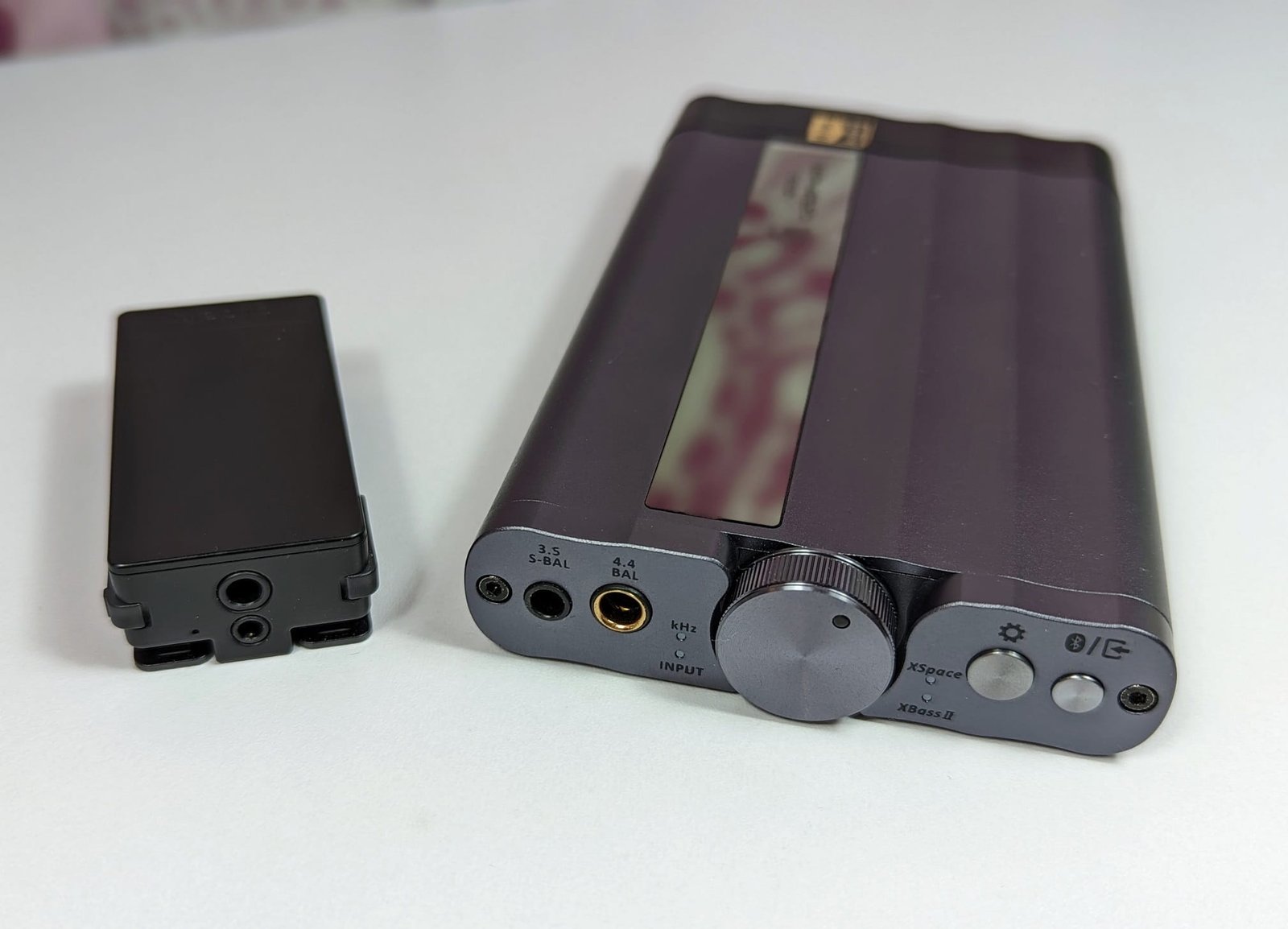
During my tests, the device's Bluetooth connection worked completely stably, and the device reliably connected to both my phone and my laptop as soon as I selected Bluetooth as the audio input channel. The Gryphon has very broad support for different Bluetooth codecs, as the list includes all different versions of the AptX codec in addition to LDAC. The device also supports MQA decoding, which is beneficial for Tidal service users. There can be many opinions about MQA as an audio format, but if Tidal is in use, I believe the sound quality is slightly better with MQA-compatible devices compared to listening to Master-quality files as they are.
The Gryphon has a 3600 mAh battery, which drains quite quickly, especially when using headphones that require more power or when playing audio via Bluetooth with the LDAC codec. I would estimate the battery life in such situations to be 6–8 hours, while at its best it can be around 10 hours. Full charging of the battery is stated to take as long as 6–12 hours depending on the charger, but fortunately, I managed with a powerful phone charger in a much more tolerable 2.5 hours. Unfortunately, it is not possible to bypass the battery, even if the device is always used connected to a ”power cord.” The Gryphon is clearly designed to be entirely battery-powered.
The amplifier included in the Gryphon provides sufficient output power for most modern headphones, regardless of whether they have a dynamic driver or a planar magnetic driver. Of the device's two headphone jacks, it is definitely advisable to use the 4.4 mm balanced connector if possible, as it provides approximately three times the power compared to the unbalanced 3.5 mm connector. For example, with a 32-ohm load, the balanced connection promises about 1 watt, while the unbalanced connection yields about 0.3 watts. The Gryphon warms up somewhat, especially when listening via Bluetooth, but not to the point of being hot.
XBass II and XSpace
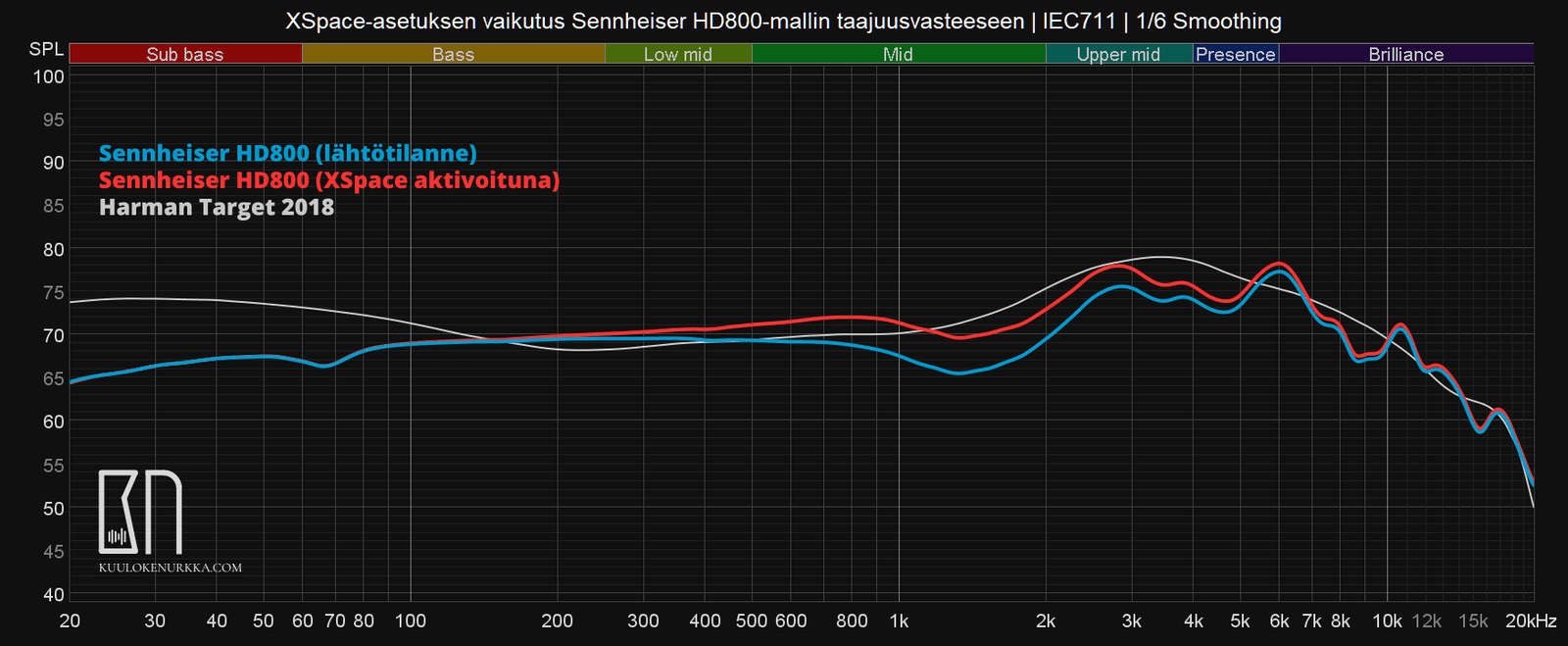
The xDSD Gryphon, like most other iFi devices, includes a fully analog XBass bass boost and an XSpace feature designed to enhance the headphone soundstage. Despite its intended purpose, XSpace is not a crossfeed function that mixes the right and left channels, but rather a pure mid-frequency boost, most prominent between 500–3000 Hz. Using this feature makes the sound clearer, but if the headphones already have accurate mid-frequencies, the result can sound quite aggressive. However, for some headphones, such as the Sennheiser HD800 (SDR mod and 2022 earpads), the setting works very well, so it's worth experimenting with your own headphones.
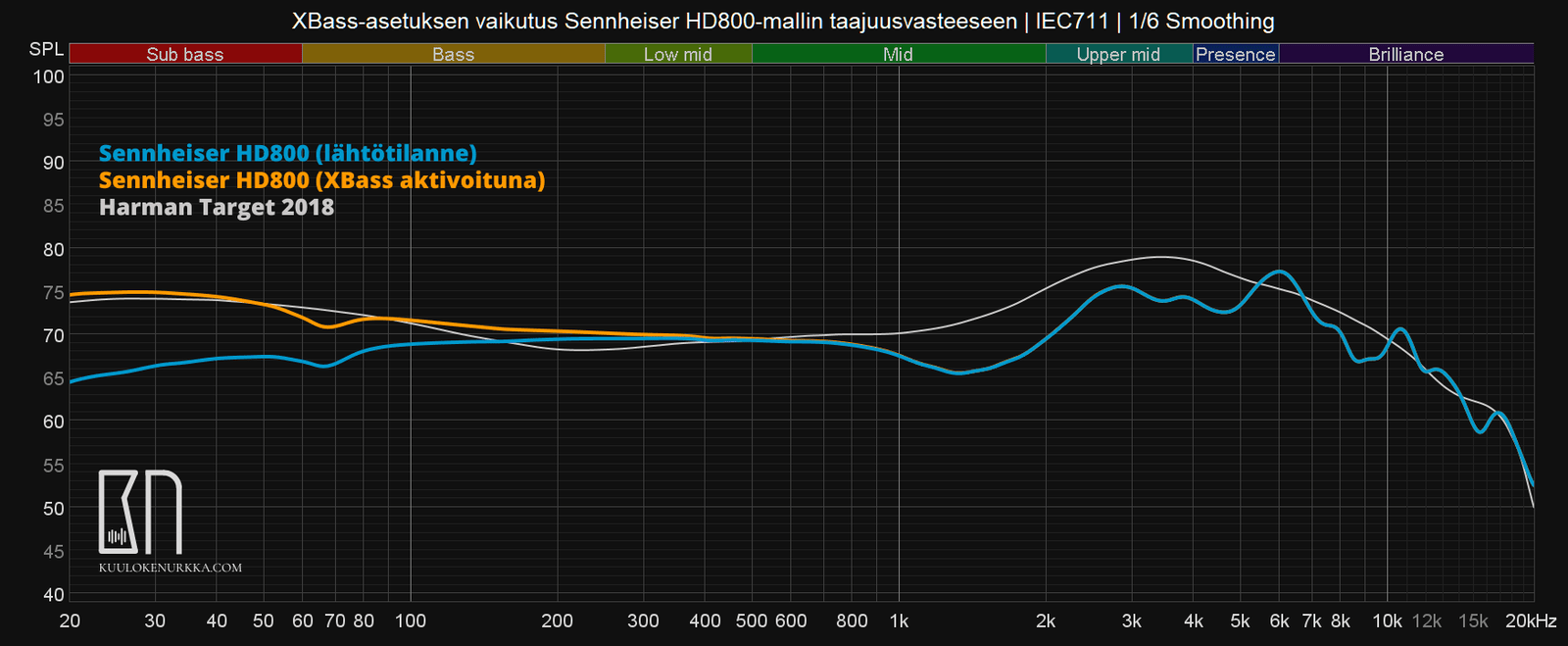
The XBass setting, in turn, boosts low frequencies between 20–200 Hz, with an emphasis on frequencies below 100 Hz. I have found this setting useful with many dynamic headphones, such as the Sennheiser HD600 and HD800, whose lowest bass frequencies normally remain subdued. Since the amount of bass is a matter of taste, adding it can also be fun for headphones that already have strong bass. The only negative aspect of the XBass setting is that the amount of distortion can increase to an audible level in the bass frequencies.
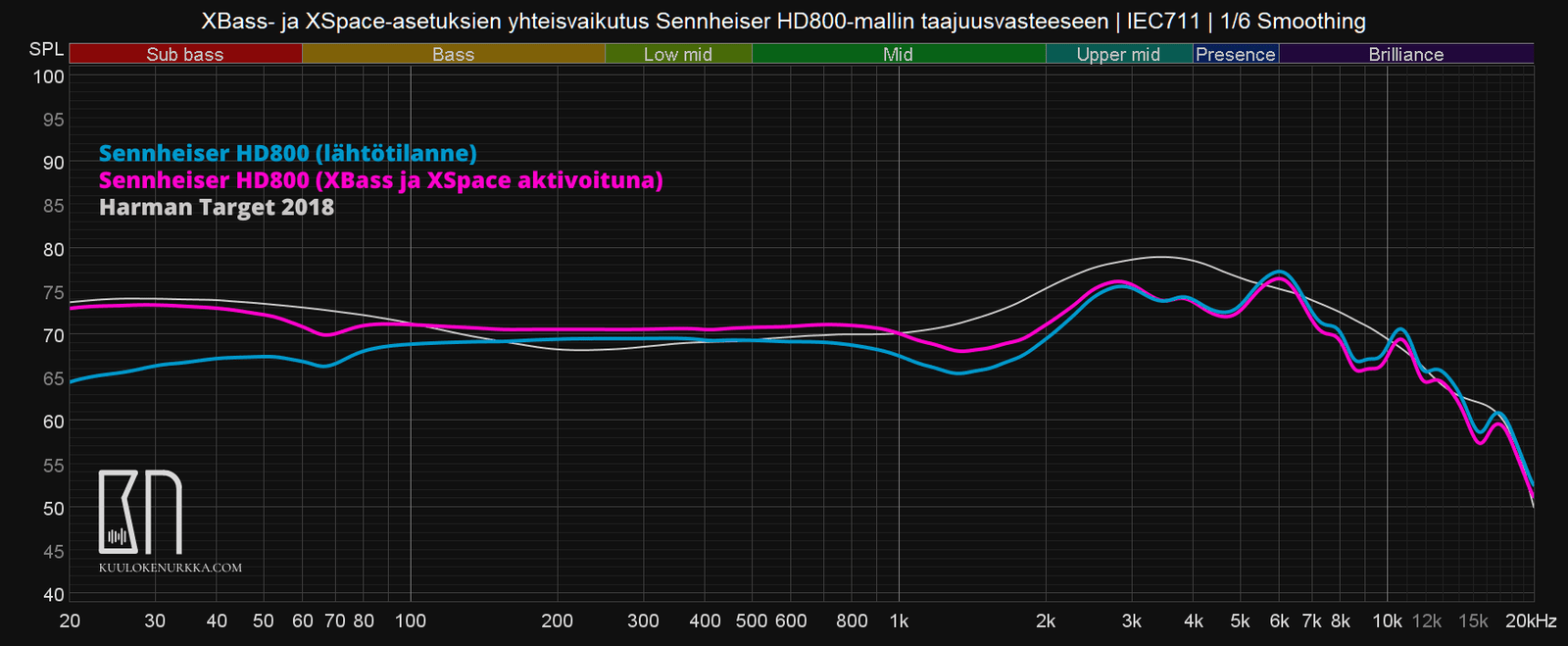
XBass and XSpace settings can also be used simultaneously, in which case they boost both low and mid-frequencies, also filling the frequency range between them. Such a combined effect is useful with bright-sounding headphones, as boosting the lower frequency ranges brings them to the same level as the treble frequencies. Among my own headphones, the SDR-modded Sennheiser HD800 sounds really good with both settings activated.
Sound quality
I tested the Gryphon for about three weeks in two different use cases: 1) as a highly mobile device using a Bluetooth connection 2) connected to a laptop with a USB cable. All other various usage possibilities make the Gryphon a truly versatile device, but due to limited testing time, I had to prioritize.
In my opinion, it is not very sensible to acquire the device as a D/A converter for separate mains-powered amplifiers, because the Gryphon's battery would constantly need charging. The device's own amplification power is also sufficient for most headphones, so it should primarily be used as a combined device.
Experiences with Bluetooth listening:
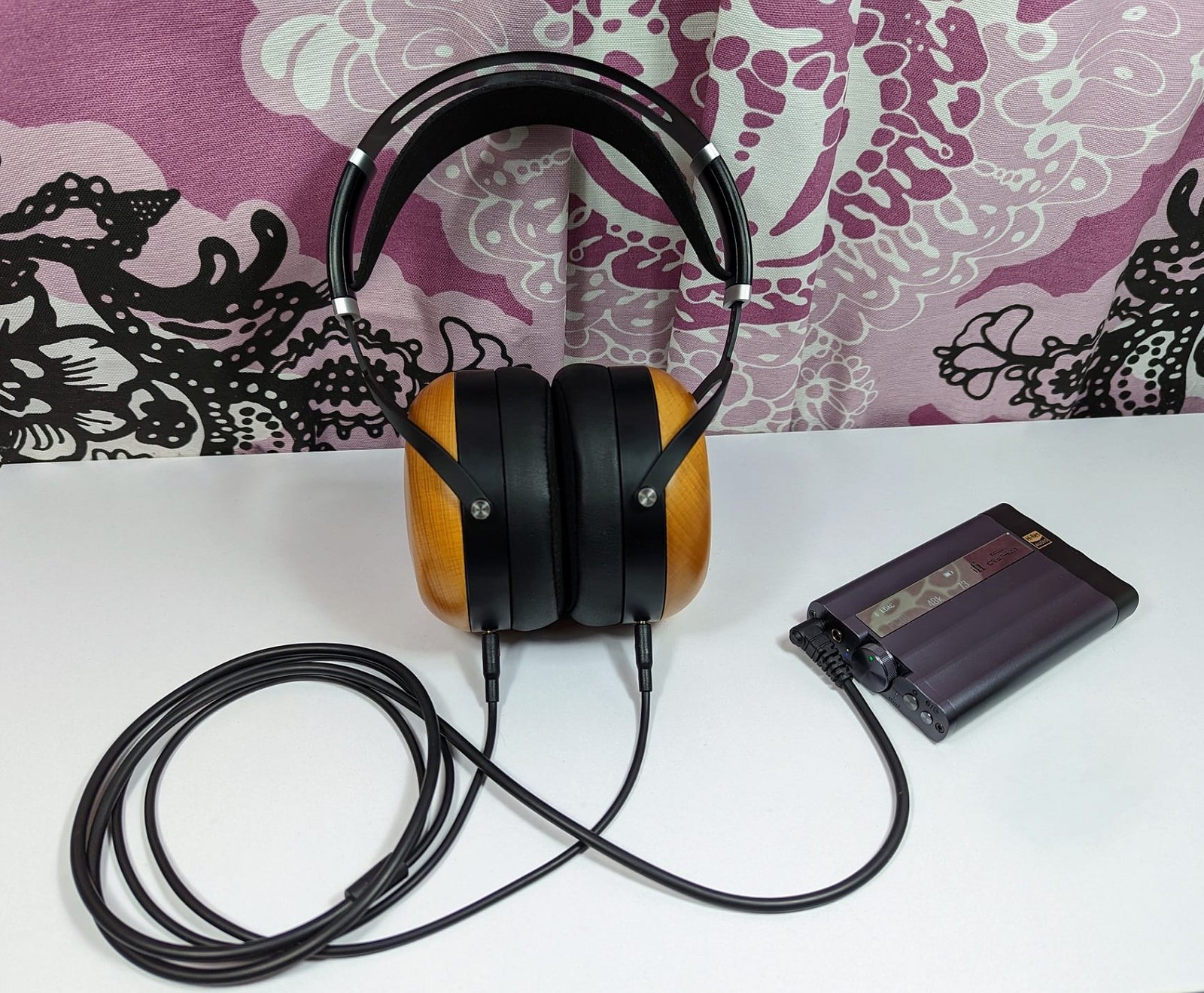
In my opinion, the Gryphon is most convenient when listening via Bluetooth, as the device can be placed, for example, on your lap or on a nearby table, where it stays firmly in place due to its sufficient weight. The device also fits in a pocket if needed, so moving around at home while listening to headphones works well.
When using the LDAC codec with a mobile phone, the sound quality, in my opinion, hardly pales in comparison to a clunkier USB connection, for example, when listening via music streaming services. The Gryphon is also too large to be ”bolted” to the back of a phone with a short cable, so for that reason too, it is more flexible to use with a Bluetooth connection.
The sound produced by the Gryphon, like other iFi devices such as the ZEN series, is pleasant to listen to: in addition to a naturally warm tone, the reproduction has a nice kick and a sense of spaciousness. All unnecessary sharpness and aggressiveness are absent. The presentation is such that one immediately immerses oneself in listening, forgetting the analysis of individual components.
iFi's more affordable combo devices, such as the ZEN DAC, sound a bit hazy when critically evaluated, whereas the Gryphon, despite its small size, is a leap forward in clarity and purity of reproduction compared to them. Compared to the ZEN series, the high frequencies also come out more strongly in the overall sound, making the Gryphon sound airier and slightly brighter. For example, Unique Melody Mest:'s impressively spacious and airy soundstage comes into its own with the Gryphon.
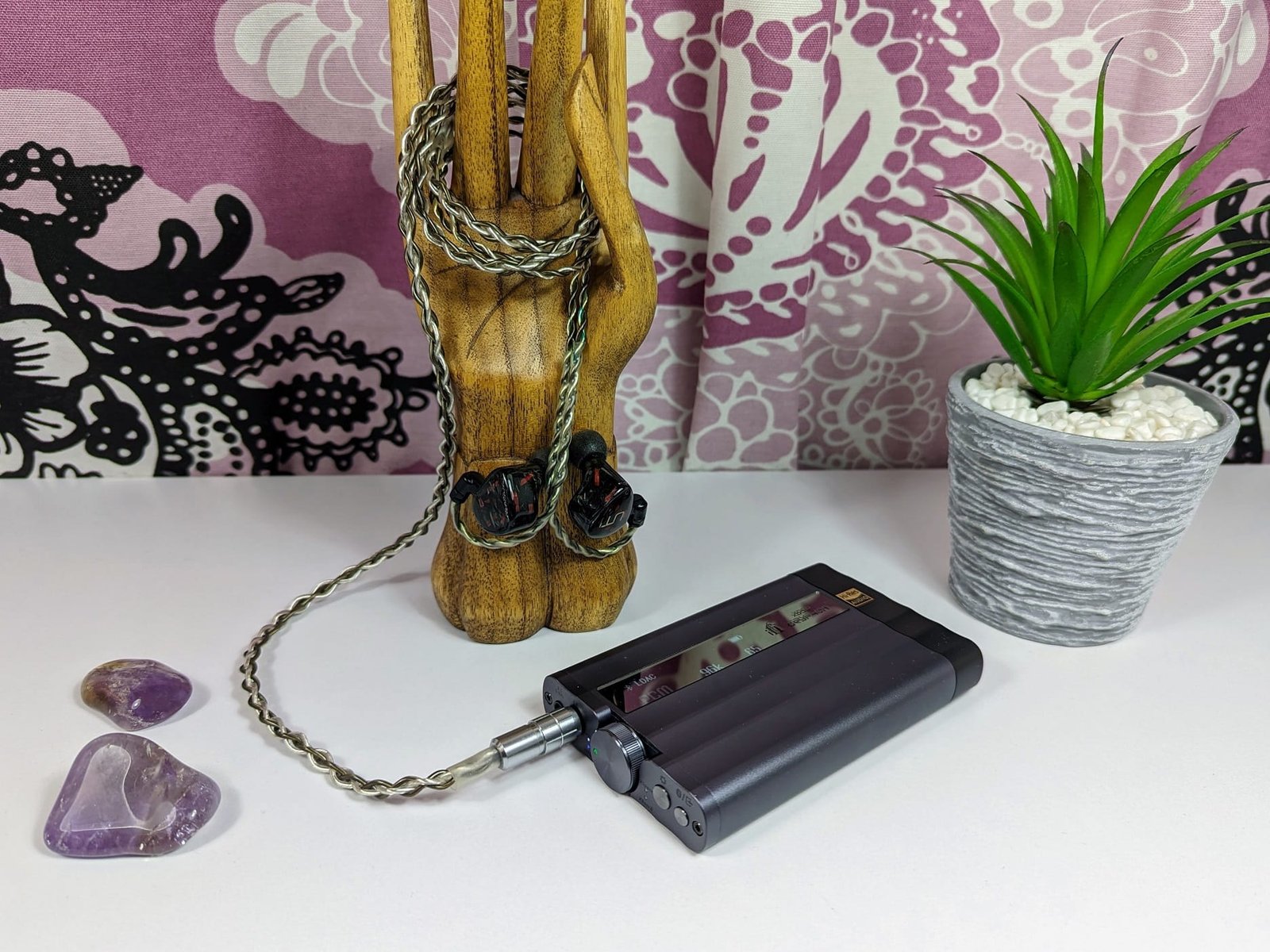
Among over-ear headphones, ZMFs, Sennheisers, and Hifimans all sound good with the Gryphon, so the presentation and output power seem versatile enough for various headphones. I would also have the sound-modifying XBass and XSpace settings available, so I don't feel like I'm missing out on anything essential compared to my larger devices. Of course, the Gryphon runs out of power with Hifiman's older and very insensitive HE6, so the most difficult-to-drive headphones still require more robust amplification. Nevertheless, I would say that all even slightly more modern headphones designed for more typical mobile use work excellently with the Gryphon.
Experiences with USB listening:
When using the Gryphon with a Windows device, it's advisable to connect it to the computer with a USB cable, as the operating system does not support the best Bluetooth codecs by default. From Windows 10, I got sound out with the AptX codec, whereas due to a bug in Windows 11, it only allowed listening with the rather poor AAC codec, even though it should also support AptX. By changing the Gryphon's settings, it is possible to listen to and charge the device simultaneously via the same USB cable. I'm not sure what this does to battery life in the long run, but at least the battery drains slower than usual this way, and I don't observe any sound quality degrading effect from simultaneous charging.
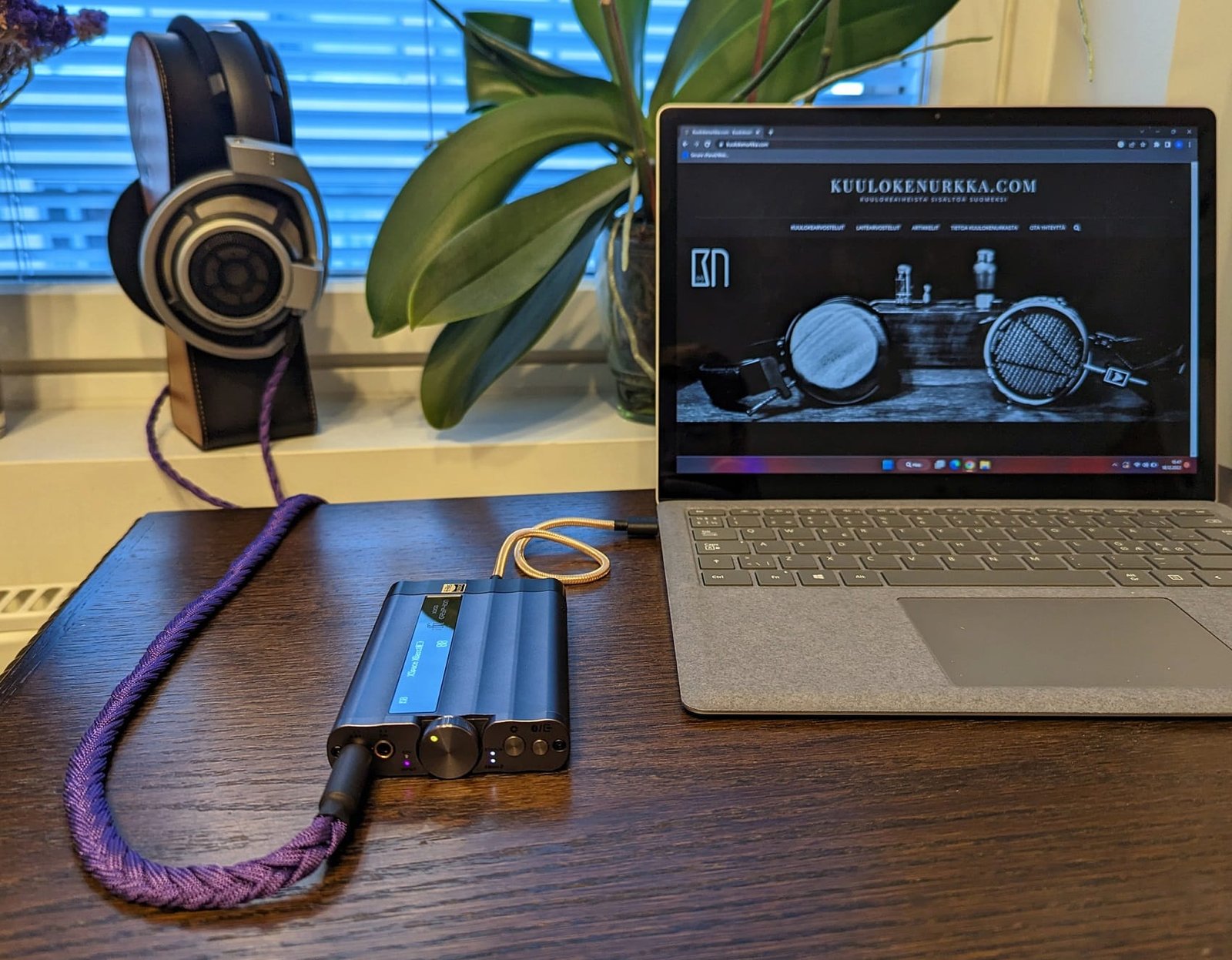
The same observations apply to wired listening with the Gryphon as to Bluetooth use. The sound is pleasant, clear, and easy to listen to. The USB connection gets the most out of high-resolution audio files. Additionally, when using the Tidal streaming service, the MQA decoding (Master quality material) enabled by the USB connection, in my opinion, clearly surpasses the LDAC Bluetooth codec in sound quality, but with the service's HiFi quality material, there is no significant difference between wired and wireless listening. Weaker Bluetooth codecs, of course, always soften the sound more, so reproduction is consistently most precise and clear via cable. The listening method does not seem to significantly alter the Gryphon's inherent sound.
The best thing about the Gryphon's sound quality is that a small touch of richness doesn't seem to detract from the clarity of the sound. The result feels so refined that it reminds me of good larger devices. For more analytical listening, there are certainly better devices that reproduce sound more sharply, but for those who prefer a more relaxed and musical presentation, the Gryphon would be a good option.
Summary
iFi's xDSD Gryphon's versatile feature set is quite a feat of engineering. I like that the device has been made consistently good in terms of construction, features, user interface, and sound quality, and no single aspect feels half-baked. Using such a device feels luxurious, but it also comes with a rather high price tag.
A retail price of over 600 euros places the Gryphon in a tough competitive situation with many significantly more affordable, albeit feature-reduced, devices. In my view, the Gryphon appeals to those who know they want to commit to using that specific device format by acquiring the best and most versatile product at once, instead of some ”intermediate model”.
Gryphon definitely deserves a plus for its smooth usability, as all settings are adjustable directly through the device without any cumbersome or slightly delayed phone application. I am sure that many still appreciate devices with physical buttons instead of fiddling with a touchscreen. Some who are wary of digital equalization might also be excited about the fully analog XBass and XSpace settings.
Most of my music listening happens sitting in a chair with large devices and headphones, so a device like Gryphon would offer new possibilities for listening. The device's sound quality is also, in my opinion, at a level that is perfectly sufficient even for those accustomed to more expensive and higher-quality listening chains. In addition, Gryphon travels effortlessly from place to place while larger devices must be left at home. The biggest challenge, however, remains carrying large headphones, as many Bluetooth headphones would take up less space and would not require a separate amplifier. However, Gryphon's potential customer base likely includes those who fundamentally desire better sound quality than Bluetooth headphones.
Gryphon only slightly annoyed me during the test period due to its relatively short battery life and quite long charging time. The device's battery is of moderate size, but the powerful amplifier and especially the Bluetooth connection inevitably consume a lot of power. A larger battery than the current one would make Gryphon thicker and heavier, so that would also have its own negative sides. The situation is a bit unfortunate, but until technology develops further, one must be prepared to adapt to constantly charging devices. Fortunately, using Gryphon is so appealing that one doesn't want to leave it uncharged.
Pros and cons:
+ Pleasantly warm-toned and clear sound
+ Pleasant airiness and freshness in the high frequencies
+ Very wide support for various Bluetooth codecs
+ MQA support for Tidal streaming service users
+ Great and practical design
+ Sturdy metal casings designed to be easily gripped
+ Balanced connector provides enough power for most modern headphones
+ Includes useful additional features such as XBass, XSpace, and iEMatch
+ All settings adjustable via the device without a phone application
+ Very comprehensive connections considering its small size
+/- It's nice that the device has a modern 4.4 mm headphone jack. However, only a few headphones come with a compatible cable, so the device buyer might also have to purchase new headphone cables.
– Battery life could be longer
– Charging can be very slow with some chargers
– Power may not be sufficient for the most demanding planar headphones
– The price is quite high compared to some of iFi's own devices, for example
 EN
EN  FI
FI