Author: Roderick
Hifiman October has now concluded. The theme month has been interesting, but admittedly a laborious project. After ten headphone reviews, I thought I would pause for a moment to reflect on Hifiman as a headphone manufacturer on a general level.
Hifiman's Headphone Lineup
Let's first examine Hifiman's lineup and how different headphones compare to each other. The following image presents the manufacturer's headphone family tree:
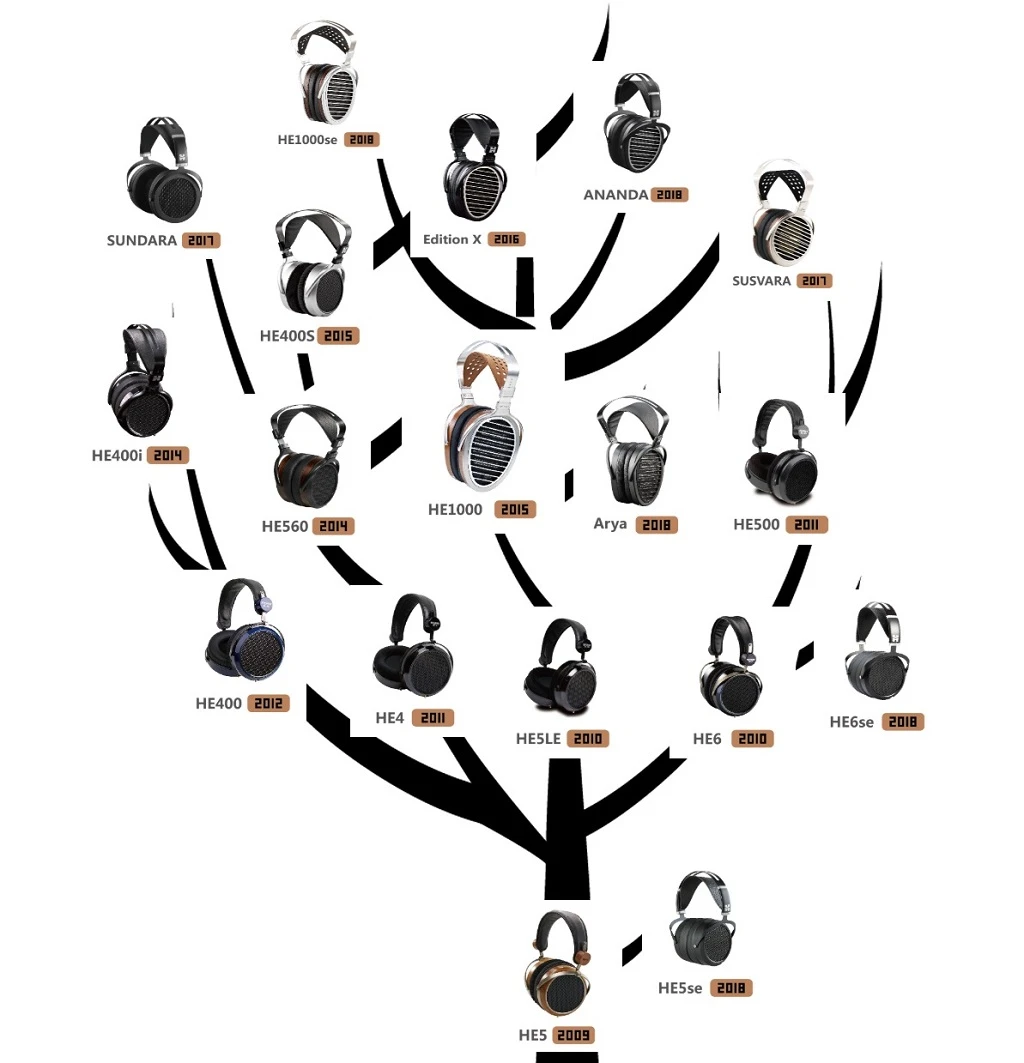
On the right side of the tree are headphones implemented with a symmetrical double-magnet structure, in the middle are headphones using an asymmetrical double-magnet structure, and on the left are symmetrical headphones with a single-sided magnet structure. I will not elaborate on the magnet structures in more detail here, as more interesting sonic differences can be observed from the headphone tree.
In my opinion, the headphones on the left are generally intense in sound and often bright. In these headphones, the soundstage places the listener in the front row. In the middle of the picture are Hifiman headphones using large egg-shaped cups, characterized by a really large soundstage where the listener follows the music from a bit further back. The sound of these headphones is marked by softness, even though the headphones are bright in treble. My own sample from this category is admittedly small, limited only to Ananda and Arya. However, softness and a large soundstage are characteristics generally considered typical for the HE1000 series headphones as well.
On the right side of the picture are headphones whose more natural place, in my opinion, would be in the middle of the picture. These headphones fall between the left-side and middle headphones in terms of their reproduction characteristics. The best headphones in terms of dynamics and bass reproduction are found on the right side of the tree. Although I have not heard any version of the HE6 headphones, I dare to make such a generalization because there is a strong consensus among enthusiasts regarding the HE6's excellent bass reproduction.
The middle and right branches of the tree converge at the manufacturer's planar flagship, the Susvara. It would seem quite logical that Hifiman would have aimed to combine characteristics from different directions of its lineup into its best headphone model. I have not heard the Susvara, but the idea of headphones that can combine HE500/HE6-style bass and dynamics with an Arya-style soundstage is fascinating.
The appearance of the Susvara also suggests that the manufacturer may have aimed for this, as the headphone cups are not large egg-shaped, but not completely round either. My experience with the Susvara-shaped HE5XX model supports this assumption. In my opinion, the HE5XX is a sonic hybrid, combining features from different-sounding Hifiman models. Thus, the HE5XX cannot be clearly placed anywhere in Hifiman's headphone tree in terms of its sound, although I believe its sound is slightly closer to, for example, the Ananda than the HE500.

Headphone Quality Issues
Almost every Hifiman headphone model exhibits more or less quality issues. Sometimes the problems relate to poor-quality cables or weak pads held together by glue. In the worst case, failing drivers become the problem. The HE5 model released in 2009 and the 2014 version of the HE560 model, however, suffered from structurally weak wooden cups. Listing all quality issues would take a while, but my ”favorite” is the paint peeling off the magnets of the over 6000 euro Hifiman Susvara.
Hifiman is, of course, not the only manufacturer with durability issues with its headphones. When planar headphones began to become common in the early part of the last decade, driver quality issues were common with other manufacturers as well. Hifiman's main competitor, the American Audeze, has, in my opinion, succeeded in overcoming the early problems better than Hifiman, although at least the LCD-4 headphones apparently still have considerable quality variation between individual units today.
French Focal's Utopia and Elear models have quality issues with the durability of the headphone drivers. I don't know if Focal has resolved the problem, but as fair compensation, Focal extended the warranty of its aforementioned models to five years. The warranty extension automatically applies to all Utopia and Elear headphone pairs, even if they were purchased before the warranty reform or, alternatively, used. It would be great if Hifiman reacted similarly whenever problems start to appear in its headphones. Unfortunately, it seems to me that Hifiman has hardly tried to improve the materials or durability of its headphones over the years. How is such a thing even possible?
It is clear that a manufacturer always aims to maximize its profits. However, profit maximization and minimization of production costs are exceptionally evident in Hifiman's case. The manufacturer has noticed that headphones sell as long as their sound quality is good. Year by year, Hifiman seems to become only more brazen in how large a price tag it can put on headphones made from cheap parts.
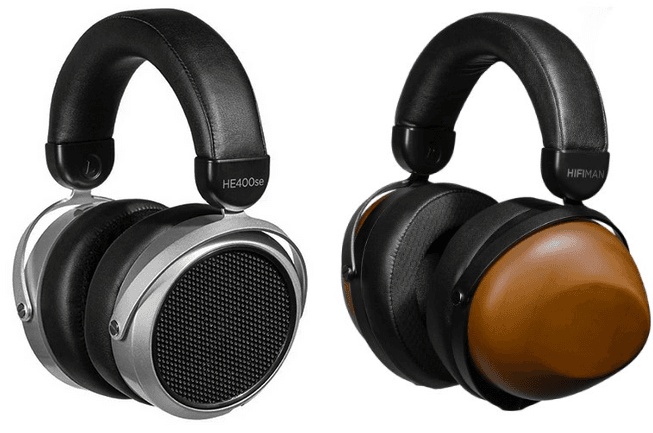
It takes quite a nerve to release 5600 euro HE-R10P headphones, whose appearance is copied from another manufacturer, and whose physical structure largely corresponds to the manufacturer's own 200 euro HE400se model. Hifiman is indeed a master at recycling old parts into its new models. Standardizing parts production leads to savings in manufacturing costs, but is it right that headphone models sold for thousands of euros have a structure whose production costs are possibly only a few tens of euros? Right or not, this concept has been successful for Hifiman.
Headphone resale value
Hifiman headphones' poor durability and limited warranty are not the only factors that diminish their resale value. The manufacturer tends to release updates to its old models very frequently – new models are also released at a rapid pace. In October 2021 alone, HE-X4, Deva Pro, and Edition XS were added as new headphones to the lineup. Furthermore, the Arya, which was only three years old, was already updated for the third time.
It is also characteristic of Hifiman that a model in production may be discontinued, while a replacement model is introduced that is significantly cheaper than its predecessor. For someone who just bought their headphones, hundreds of euros might instantly disappear from the headphones” resale value. This also leads to peculiar situations with official headphone retailers. In Finland, Edition X headphones are still sold today for 1759 euros and the HE560 model for 1059 euros. The Edition X was replaced in 2018 by the Ananda, costing ”only" 1000 euros, which is also rapidly becoming a discount bin product. Similarly, updated versions of the HE560 model are sold globally for as little as 200 euros.
For those acquiring new headphones, the situation is certainly pleasant, as previously expensive technology is available at increasingly lower prices. However, I do not understand how such a blatant disregard for previous customers is accepted among consumers. It is difficult to think of any other hobby besides high-end audio where something similar is overlooked without much grumbling.
CEO and Founder Fang Bian
To better understand Hifiman's operations, it is useful to get to know the man behind the brand. Hifiman was founded in 2007 by Fang Bian, who holds a Ph.D. in chemistry from New York University. In his studies, he specialized in nanotechnology. In interviews, Bian has stated that his passion for music and audio reproduction ignited when he received his first Walkman at the age of 10. As an adult, he began to consider how he could combine his hobby and professional expertise in nanotechnology. Hifiman originated from this reflection.
Bian is an interesting personality, about whom a great ”human-interest story” could certainly be written. However, having followed Hifiman's development for years from the sidelines, I have formed an impression of a person who genuinely struggles to understand causes and consequences. Bian often manages to appear arrogant in his communication, even if he may not be so at heart. Indeed, in his public appearances, the man is sometimes quite a PR disaster.
On this video, Fang Bian presents the Susvara headphones (at the time, the headphones were still called Edition 6) and RE2000 in-ear headphones to Tyll Hertsens. In the interview, Bian accidentally refers to the RE2000 earbuds as ”RE two thousand dollars,” which is a funny slip of the tongue in itself, but not particularly amusing in the context that Hifiman had already been accused of overpricing its products.
Mixed amusement and annoyance were also aroused by how Bian justified the Susvara's $6000 price tag. ”Because it sounds good – koska se kuulostaa hyvältä” is not necessarily an answer that a professional PR agency would have approved. The enthusiast community expressed its dissatisfaction on the Head-fi forum, where Bian tried to defend himself. Head-fi's moderators were busy trying to protect their main sponsor from criticism, but also to prevent Bian himself from making further blunders. Due to the treatment he received on the forum, Bian even compared himself to the victims of China's Cultural Revolution. The episode as a whole could be described as, at the very least, a peculiar launch for a new product.
A kind of repeat of the blunders following the Susvara release was seen in early 2021, when Hifiman launched the HE-R10P headphones, which borrowed their appearance and name from Sony's R10 model released in 1989. The original R10 is an exceptionally highly regarded headphone model, for which thousands of euros are still paid today.
At the launch event for the HE-R10P headphones, Fang Bian laughingly stated that Sony could not sue him because the R10 patent had expired. Originally, Hifiman's headphones were marketed as an ”homage” to the old Sony R10 model, but at the launch event, Bian focused mainly on criticizing Sony and praising his own R10P model. It is, of course, normal to praise one's own product, but boasting about copying another manufacturer's design and outright disparaging a competitor deservedly earns one a reputation as a boor. The release of the R10P caused resentment on Western discussion forums as well as in China. I followed the discussion on the erji.net website, and there were hardly any sympathizers for Fang Bian's behavior.

In my opinion, Hifiman as a manufacturer very much resembles its founder. The company is ambitious in its products, but audacious in its pricing. This is precisely the image that founder Fang Bian has also managed to project of himself.
Finally
No matter what price headphones a consumer is looking for, Hifiman has a model that is one of the best headphones in its price range. No other manufacturer has such comprehensive representation in all different price categories. Especially the affordable HE400se and Sundara offer excellent value for money.
Although traditional manufacturers like Sennheiser, Beyerdynamic, and Grado had a head start of decades, it took Hifiman less than ten years to rise, in my opinion, to become the world's most significant high-end headphone manufacturer. I don't believe its position is at risk in the coming years either, unless Audeze succeeds in developing good products that cost significantly less than the LCD-2 Classic. I also believe that the manufacturer who first succeeds in combining open high-end headphones with well-implemented digital signal processing will be quite strong in the competition. A large company like Apple could, with its resources, develop all kinds of headphones, but it is certainly more profitable for Apple to focus on different types of headphones.
The excellent sound quality of Hifiman headphones cannot be denied, but other aspects and factors also weigh in when choosing headphones. I am not pleased with the poor structural quality of the headphones, the price dumping at the expense of old customers, and especially not the ”take the path of least resistance” mentality. If I pay hundreds or thousands of euros for headphones, sound quality alone is not enough. I don't like that Hifiman constantly lowers the bar with its actions – expensive headphones must also look and feel high-quality.
I hope that the quality standards followed by Hifiman never become more widely accepted standards for other manufacturers. However, I will continue to recommend Hifiman headphones in the future when I believe there is a reason for such a recommendation. I am particularly interested to see how the recently released Edition XS headphones are received, and whether they might be headphones that, like the Sundara, can redefine how good sound quality is available at an affordable price.
 EN
EN  FI
FI